
Retail Sales Scripts: What They Are and How They Work
Retail sales scripts are flexible conversation guides for recurring in-store interactions. They organise prompts, questions, talking points and transitions, while the customer's response determines what should happen next; they are adaptable guidance, not mandatory word-for-word dialogue or a guarantee of a sale.

Retail sales scripts at a glance
This overview shows the article's central relationship: prepared guidance supplies structure, but customer cues control the next conversational move.
- What it is
- A prepared set of talking points, questions, prompts or example wording for recurring retail conversations.
- Primary function
- Support conversation structure, recall and consistent core messaging without requiring identical conversations.
- Common components
- Opening cues, discovery questions, talking points, transitions, objection prompts and closing or next-step language.
- Adaptation rule
- Change the next prompt when the customer's need, concern, preference, question or readiness changes the relevant direction.
- Important boundary
- A script guides the interaction; it does not replace active listening, staff judgement or situational understanding, and it cannot guarantee a sale.
How the guidance works
- Customer situation
- Prepared prompt
- Customer response
- Adapt next move
The loop can repeat, compress or skip stages. The useful constant is the decision rule: listen to the response before choosing the next prompt.
A useful script therefore provides reusable structure with room for responsive judgement. Its value depends on how well the wording, product context, store context and staff behaviour fit the customer's actual situation.
Table of Contents
What Is a Retail Sales Script?
A retail sales script is a prepared set of talking points, questions, prompts, or example wording used to guide a customer interaction in a retail setting.
It functions as a conversation guide for recurring retail situations with a defined conversational purpose.
Prepared wording distinguishes a retail sales script from a completely spontaneous conversation, while adaptation allows staff to respond to the customer rather than simply repeat fixed lines.
The guidance may be detailed or take the form of a flexible talk track, provided its prompts and purpose remain clear during the interaction.
The illustration represents this prepared guidance within a live customer interaction.

A retail sales script is not mandatory word-for-word dialogue; it provides guidance staff can return to and adapt to the situation.
Why Retail Sales Scripts Are Used in Stores
Retail sales scripts are used to give retail staff repeatable conversational support for common selling situations while leaving room to respond to individual customers.
Their purpose is to provide structure and consistency, not to guarantee a particular sales outcome.
Stores may use scripts to help staff recall key information, maintain core messaging, and support staff onboarding without requiring identical conversations.
The structure can guide the interaction while active listening and the customer response determine how the associate adapts the wording.

- Conversation structure: a talk track can give staff a practical starting point for opening, developing, and continuing a customer interaction.
- Key information: prompts can remind staff to cover relevant questions or important product information when it fits the conversation.
- Staff onboarding: structured support can give less-experienced associates a reference for recurring situations while they develop judgement and confidence through practice.
- Consistency: shared talking points can help a store communicate core messaging more consistently while still allowing flexible use.
For example, a less-experienced associate may use a script to remember an appropriate opening and a useful follow-up question, then change the next prompt based on the customer's answer.
In that situation, the script supplies a starting structure, while active listening remains necessary for a responsive conversation.
What a Retail Sales Script Contains
A retail sales script can contain an opening cue, discovery questions, talking points, transition language, an objection prompt, and a closing cue or other next-step language.
The exact component set can vary with the store, product, customer situation, and purpose of the script.
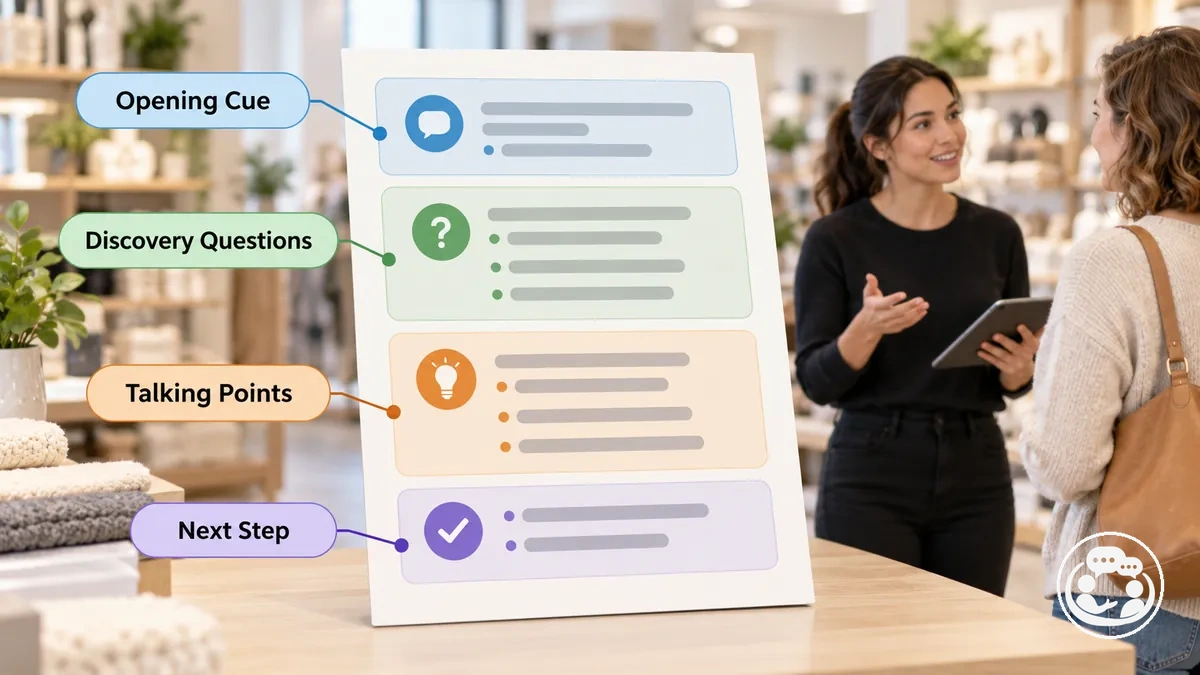
Each component supports a different function within the customer interaction rather than forming a fixed sequence that every script must follow.
Together, the components provide prepared guidance for identifying a customer need, communicating relevant information, and moving the conversation forward.
- Opening cue: provides a prepared greeting or starting point for the first interaction with the customer.
- Discovery questions: prompt the associate to gather information about the customer need while listening to the response.
- Talking points: provide relevant product or value information that can be selected according to what the customer has said.
- Transition language: connects conversational topics without requiring a fixed word-for-word sequence.
- Objection prompt: provides a response prompt for acknowledging a concern and addressing relevant information.
- Closing cue: provides appropriate next-step language when the interaction is ready to move toward a decision, further assistance, or another action.
For example, a discovery question may reveal that a customer needs a particular product feature, while a related talking point supplies information relevant to that need.
The question and talking point serve different functions within the same retail sales script, and the required component set still depends on the situation rather than a fixed template or exact formula.
How Retail Sales Scripts Work Across a Customer Conversation
Retail sales scripts provide stage-specific guidance across a customer conversation rather than one uninterrupted block of memorised dialogue.
The guidance changes with the customer's response, so each conversational move can support the next appropriate interaction.
A typical progression may move from greeting to needs discovery, recommendation, response to a customer concern, recognition of a buying signal, and closing.
These conversation stages are not a mandatory sequence: they may compress, repeat, or be skipped when the interaction develops differently.

- Greeting: the script can guide an appropriate opening, while the customer's initial response indicates whether to continue, pause, or adjust the next conversational move.
- Needs discovery: questions help clarify customer needs, and the answers determine which information or topic is relevant next.
- Recommendation: the talk track can connect a relevant product or option to the need already expressed, with further adaptation if the customer asks for another feature or alternative.
- Customer concern: a response prompt can help acknowledge and clarify a concern before the associate decides whether more information, another question, or a different option is appropriate.
- Buying signal: signs of readiness can guide the associate toward a reasonable next step, but they do not prove that the customer is ready to complete the purchase.
- Closing: closing language can support the next appropriate action when the interaction has reached that point, while the customer's response still determines whether to proceed, clarify, or continue the conversation.
For example, a customer answering a needs-discovery question may reveal that a suggested feature is not relevant, so the next script prompt can shift to a different need instead of continuing with the original recommendation.
This adaptation keeps retail sales scripts responsive to the conversation rather than turning them into a fixed sales-cycle formula.
Common Types of Retail Sales Scripts
Types of retail sales scripts can be grouped by the conversational function they support in a retail customer interaction.
Common categories include greeting, needs-discovery, product-recommendation, objection-response, and closing scripts.

The classification is based on the job each script supports rather than minor wording differences or channel-specific sales terminology.
Each type becomes relevant when a particular customer situation calls for that conversational function.
- Greeting script: supports the opening or first contact when an associate needs a suitable way to begin engaging with a customer.
- Needs-discovery script: focuses on questions that help clarify customer needs and gather information relevant to the interaction.
- Product-recommendation script: supports explaining a relevant product or value point when the customer's stated need provides a basis for a recommendation.
- Objection-response script: becomes relevant when a customer raises a concern and the associate needs a structured way to acknowledge, clarify, and respond to it.
- Closing script: supports an appropriate next step when the customer appears ready to make a choice, seek further assistance, or conclude the interaction.
One flexible retail sales script can combine several of these functions, and the boundaries between types can vary with the store's selling process and the customer situation.
These categories describe conversational jobs rather than complete standalone methods or rigid script formats.
What Retail Sales Scripts Look Like in Practice
Retail sales scripts in practice usually appear as adaptable prompts or short exchanges that guide an associate while leaving room for the customer response. The next line changes with the situation rather than following one fixed block of dialogue.
The examples below show the practical pattern: situation → prompt → customer response → adaptation. Each prompt supplies a starting point, while the customer's cue determines whether the associate should continue, pause, clarify or change direction.
Three examples of script adaptation
Greeting
- Situation
- A customer enters and begins browsing without asking for help.
- Prompt
“Hi, let me know if I can help you find anything.”
- Customer response
- “Thanks, I’m just looking.”
- Adaptation
- The associate gives the customer space instead of continuing with a fixed sequence of questions.
Needs discovery
- Situation
- A customer says they need a jacket for wet weather.
- Prompt
“Will you mainly be wearing it for everyday use or longer periods outdoors?”
- Customer response
- “Mostly walking to work.”
- Adaptation
- The next question or recommendation can focus on features relevant to that stated use rather than unrelated options.
Recommendation
- Situation
- A customer says they prefer something lightweight.
- Rigid approach
- Continue with the same prepared product description even though the customer's stated priority has changed what is relevant.
- Adapted prompt
“If keeping the weight down matters most, would you like to compare the lighter options?”
- Why it adapts
- The line responds to the customer's stated preference instead of ignoring it.
These examples show why a retail sales script works as guidance rather than a canned phrase: listening to the customer's cue determines the next line.
Retail Sales Scripts vs the Retail Sales Process
A retail sales script and a retail sales process differ mainly in scope and function.
A retail sales script guides conversation language or a specific conversational move, while the retail sales process organises the broader sequence of selling activities that a retailer may use.
The comparison is clearest when both concepts are assessed by what they control, their level of detail, their unit of use, their relationship to a process stage, and the role of adaptation during execution.
| Comparison criterion | Retail sales script | Retail sales process |
|---|---|---|
| What it controls | Guides prompts, conversation language, and possible conversational moves during a customer interaction. | Organises the broader sequence and relationship of selling activities. |
| Level of detail | Operates at the language or interaction level, such as a question, response prompt, or talk track. | Operates at a broader activity level and defines how stages or selling tasks relate to one another. |
| Typical unit of use | A prompt, short exchange, conversation guide, or alternative next line. | A process stage or broader selling activity that may contain several possible interactions. |
| Relationship to stages | Can be used within one or more process stages depending on the customer situation. | Provides the larger structure within which different script options may be used. |
| Adaptation | May change immediately with the customer response and the next conversational move. | May vary by retailer, while individual interactions within the process can still require local adaptation. |
For example, one retailer might include product recommendation as a process stage, but that stage can contain several different script prompts depending on what the customer has already said.
A customer asking for a lighter product may call for a different prompt from a customer prioritising durability, even though both interactions remain within the same process stage.
The sales process therefore provides the broader structure, while the retail sales script provides adaptable language-level guidance within it.
Benefits and Limitations of Retail Sales Scripts
The benefits and limitations of retail sales scripts depend on how the scripts are designed, delivered, and adapted to the customer context.
A script can support consistency and structure, but the same structure can become restrictive when staff rely on prepared wording without sufficient adaptation or active listening.
The main trade-offs can be evaluated across consistency, training support, coverage of key talking points, adaptability, listening quality, natural delivery, and fit to the customer's situation.
| Operational dimension | Potential benefit | Limitation or condition |
|---|---|---|
| Consistency | Can support more consistent core messaging across recurring customer interactions. | Can become restrictive when consistency is treated as a requirement to use the same wording regardless of the customer response. |
| Training support | Can give less-experienced staff a structured reference for common conversations. | Its usefulness depends on staff developing judgement rather than relying on the script as a substitute for situational understanding. |
| Key talking points | Can help staff remember relevant questions, product information, or value points during an interaction. | Prepared talking points may become distracting or excessive when they are introduced without regard to what the customer actually needs. |
| Adaptability | A flexible script can provide a stable starting point while allowing the associate to change the next conversational move. | Adaptability may be limited when the script design or its use leaves little room to respond to new information. |
| Active listening | Prompts can support focused questions that help the associate gather relevant information. | Active listening can weaken when attention shifts from the customer's response to remembering or completing prepared lines. |
| Natural delivery | Prepared guidance can support a clear conversational structure when the associate uses it in their own natural delivery. | The interaction can sound robotic or pushy when prepared wording is repeated rigidly without adjusting tone, timing, or phrasing. |
| Customer context | A script is more useful when its prompts reflect the store context, product complexity, customer needs, and current interaction. | A script may fit poorly when those conditions differ from the situation it was designed to support. |
For example, the same prepared wording may provide useful structure when an associate listens to the customer and adapts the next line, but it can sound unnatural when repeated despite a different customer response.
Whether a retail sales script functions as useful guidance or a constraint therefore depends on script design, staff skill, store context, product complexity, customer needs, and the quality of adaptation during the interaction.