
Handling Retail Sales Objections Without Pressure
Handle retail sales objections without pressure by responding to the shopper’s stated concern, not a guessed motive: listen, acknowledge, clarify only what is unclear, give the relevant fact or realistic option, and check whether the concern is resolved. If the shopper clearly says no or asks for time, privacy, or space, stop the objection-handling attempt.

Retail objection response path
Choose the next move from what the shopper has actually expressed. Specific wording supports a specific response; ambiguity supports clarification; a clear boundary stops the process.
- Specific concern
- Acknowledge it, answer the stated issue, then verify whether it is resolved.
- Vague hesitation
- Ask a brief neutral clarifier before choosing a response.
- Information question
- Answer the question directly; do not invent an objection behind it.
- Refusal or request for space
- Respect the boundary and stop pursuing the objection.
- Listen
- Acknowledge
- Clarify
- Respond
- Verify
Decision boundary: the five-step sequence applies only while the shopper is willing to continue. An explicit no, request to stop, or request for space takes priority over another sales response.
The sections below show how to recognise the shopper’s state, apply the five actions, adapt the response to the concern, and know when to stop.
Table of Contents
Recognizing a Retail Sales Objection Before Responding
Before responding to a retail sales objection, distinguish a specific objection from unresolved hesitation or an information request.
The diagnostic goal is to identify what the shopper has actually expressed, using specificity and observable language rather than guessed intent.
A specific stated reason confirms a concrete shopper concern, while vague uncertainty suggests hesitation that needs clarification.
A direct product question indicates an information request unless the shopper also states an objection, while an explicit refusal establishes a clear boundary.
Repeated uncertainty or a request for time can have several interpretations, so the signal alone does not establish the underlying concern.
The diagnostic comparison separates observable evidence from interpretation so the associate can choose an appropriate next response without answering too early.
| Observed customer signal | Likely state | What still needs clarification | Appropriate next response |
|---|---|---|---|
| A specific reason, such as “This size does not fit me” | Specific objection | Whether the stated concern is the issue the shopper wants addressed | Acknowledge the concern and respond to the stated issue |
| A vague statement such as “I’m not sure” or repeated uncertainty | Unresolved hesitation | What, if anything, is causing the uncertainty | Ask a brief clarification question rather than assuming the concern |
| A direct question about a feature, material, use, or availability | Information request | Whether information alone is needed or a related concern also exists | Answer the question directly and allow the shopper to decide whether to continue |
| An explicit statement such as “No, I’m not interested” | Refusal | Nothing unless the shopper voluntarily continues the conversation | Respect the refusal and give the shopper space |
For example, “I need some time” could reflect uncertainty about the product, a wish to compare options, or simply a request for space; tone, silence, or hesitation alone is not definitive proof of a hidden objection.
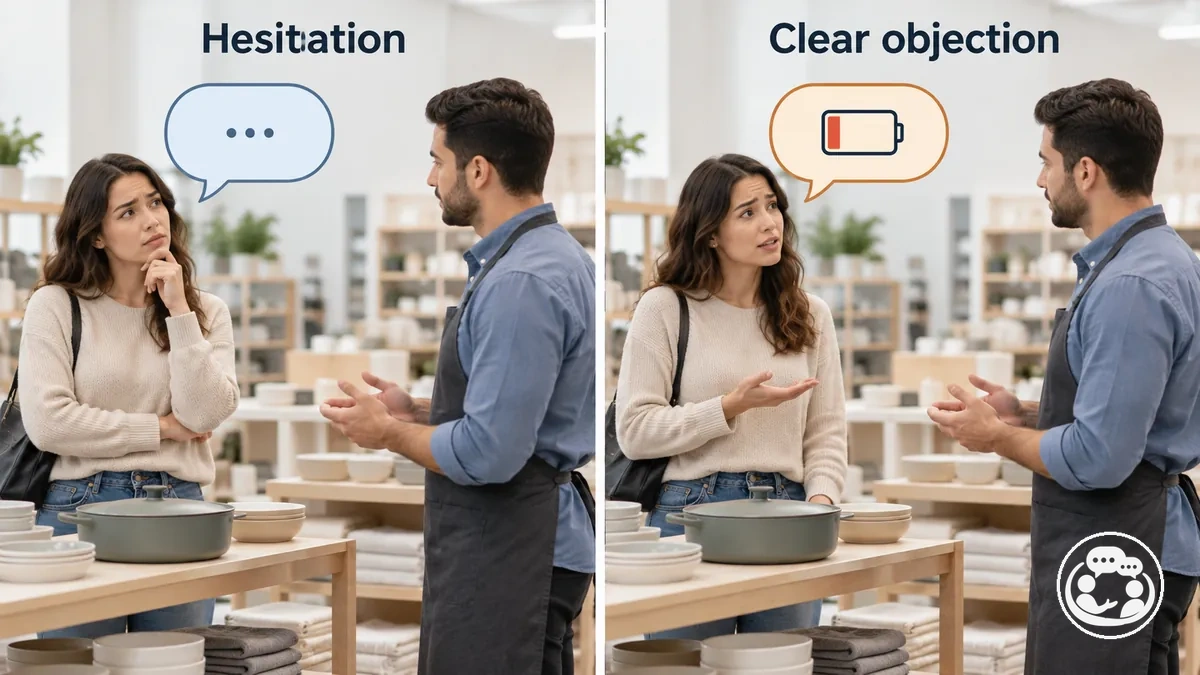
The illustration shows how observable wording can distinguish a specific concern, vague hesitation, and information-seeking question without assigning hidden intent.
When the evidence does not establish the shopper's meaning, clarification should come before interpretation or response.

How Hesitation Differs From a Clear Objection
Hesitation may reflect uncertainty without a stated reason, while a clear objection expresses a specific concern that can be addressed directly.
The shared comparison basis is how much specific concern information the shopper has actually expressed.
Comparing specificity, available evidence, clarification need, and response readiness shows whether the associate has enough information to respond.
| State | What the shopper has expressed | Clarification need | Response implication |
|---|---|---|---|
| Hesitation | Uncertainty without an identifiable stated reason | Clarification is needed to determine whether a specific concern exists | Clarify the uncertainty before choosing a direct response |
| Clear objection | A stated reason that identifies a specific concern | Clarification is needed only where the stated concern remains unclear | Respond directly to the specific concern the shopper has expressed |
Hesitation alone does not establish purchase readiness, and neither hesitation nor a clear objection should automatically be treated as a buying signal.
When no specific concern has been stated, preserve the uncertainty and seek clarification rather than inferring the shopper's intent.
The comparison graphic illustrates the difference in verbal specificity rather than hidden intent.
When the Stated Objection Is Not the Underlying Concern
A stated objection may be broad or incomplete without being false or deceptive.
The underlying concern may involve fit, timing, trust, product suitability, or another condition, but clarification is needed before the associate can determine whether the first statement identifies the issue accurately.
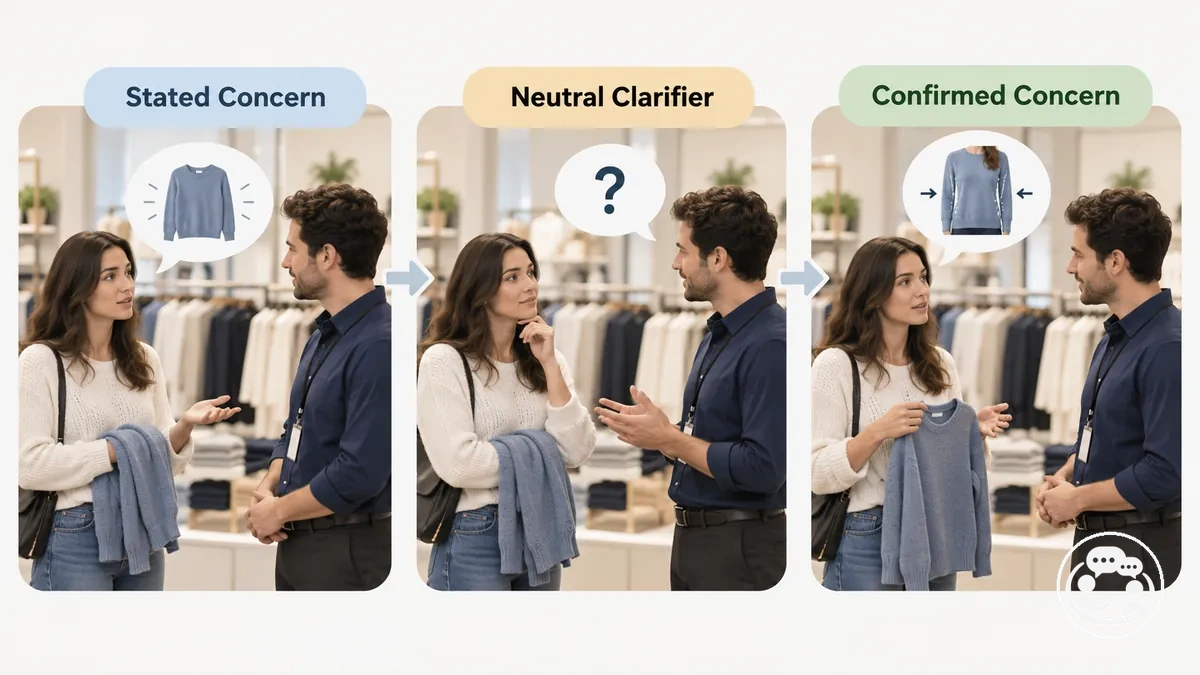
How to move from a broad objection to a confirmed concern
- Start with the stated concern. Treat the shopper’s words as the current evidence rather than assuming an unstated motive.
- Use a neutral clarifier. Ask for the missing detail without steering the shopper toward a predetermined explanation.
- Use the shopper’s confirming detail. If it confirms the original concern, keep that concern as the response target; if it identifies a different issue, use the newly confirmed issue instead.
- Choose the response from the confirmed concern. Tailor the information or option to what the shopper has actually clarified.
For example, a shopper who broadly says a product is “not right” might clarify after a neutral follow-up question that fit is the specific concern.
The annotated example shows how additional customer wording changes the interpretation from a broad stated objection to a confirmed concern.
The associate should confirm that detail before tailoring the response.
A Low-Pressure Method for Responding to Objections
A low-pressure objection-handling method follows five actions in order: listen, acknowledge, clarify, respond, and verify.
The method keeps each response tied to the shopper concern while leaving the shopper decision as the boundary for whether the conversation continues.
This sequence fits within broader retail sales script fundamentals without requiring a rigid memorised script.
The order reduces premature responses by gathering and confirming relevant information before an answer is offered.
Each stage moves forward only when the available information and the shopper's willingness to continue support the next action.
- Listen fully: Gather the shopper's stated concern and relevant evidence before deciding what response is appropriate. Move forward when the shopper has had space to explain the concern.
- Acknowledge the concern: Recognise what the shopper has expressed without immediately arguing against it. Continue when the concern has been accurately understood.
- Clarify when needed: Reduce ambiguity when the concern is not specific enough to answer accurately. If the concern is already clear, proceed without unnecessary questioning.
- Respond with relevant information or options: Address the confirmed concern with information or suitable alternatives rather than unrelated persuasion. Offer options only when they are relevant to what the shopper has expressed.
- Verify whether the concern is resolved: Check whether the response addressed the concern and whether further discussion is welcome. If the shopper does not want to continue, respect that shopper decision and give them space.
The image organises the progression from understanding the shopper concern to verification and shows that the shopper's decision controls whether the conversation continues.
The sequence moves from understanding to an appropriate response without turning verification into compulsory persuasion.
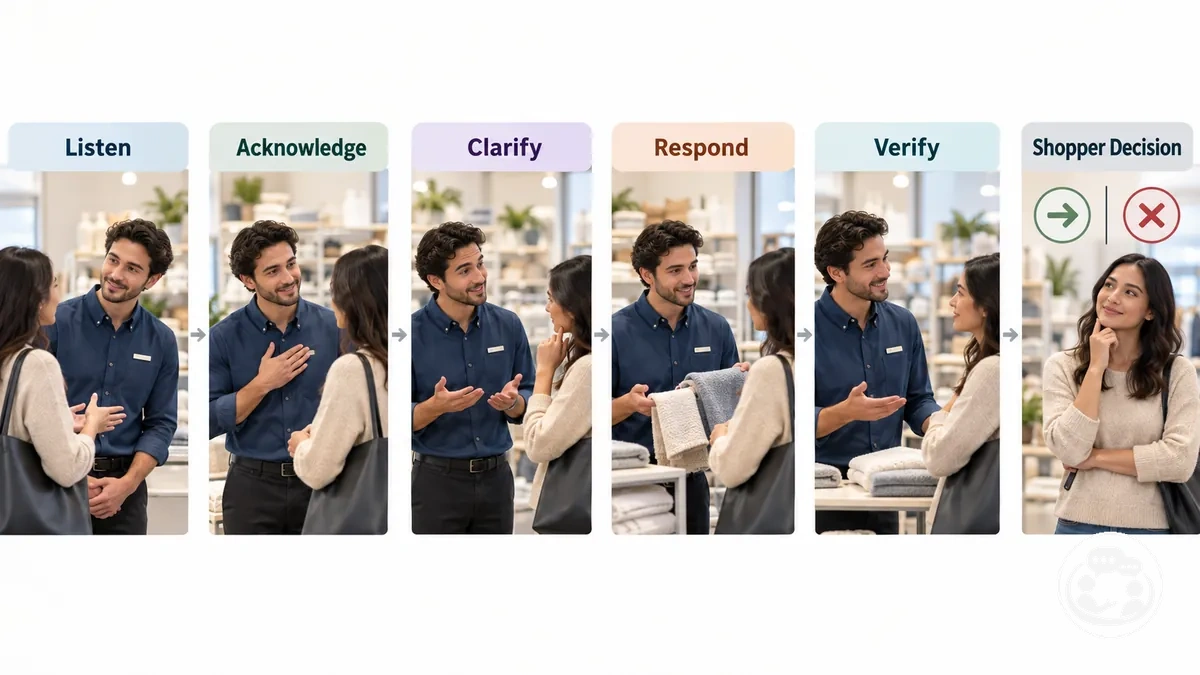
The method remains adaptable to the condition of the conversation: a clear concern may require little clarification, while an ambiguous concern may require brief clarification before a relevant response.
Verification is the stopping point when the shopper indicates that the concern is resolved or that they do not want to continue.
Listen to the Full Concern Before Responding
Listen fully to the shopper concern and let the shopper finish before composing or delivering a response.
Hearing the full statement provides the key wording and context needed to respond to what was actually said rather than to an early interpretation.
Do not interrupt while the shopper is completing the concern.
Note or reflect the key wording, and distinguish whether the concern is specific or still vague before deciding what the statement means.
Separate the shopper's observable words from any assumption about intent; tone, pauses, or silence may suggest context but do not prove what the shopper means.
This listening discipline gives the associate more accurate information for the next response.
The image demonstrates giving the shopper enough conversational space to finish the concern before the associate replies.

Acknowledge the Concern Without Arguing
Acknowledge the shopper's concern by recognising what they have raised without treating acknowledgment as agreement or concession.
Key distinction: acknowledgment is not agreement
Acknowledgment
Shows that the concern has been heard without requiring the associate to accept the shopper’s interpretation as fact. Neutral wording such as “I can see that this feature is a concern for you” recognises the point without claiming that the product is unsuitable.
Argument or rebuttal
An immediate response such as “That isn’t really a problem” shifts the exchange toward disproving the shopper’s concern. Avoid acknowledging the concern and then cancelling that recognition with an argumentative pivot.
Keeping acknowledgment separate from agreement and rebuttal helps maintain a factual, respectful conversation.
Ask a Clarifying Question to Find the Underlying Concern
Ask a clarifying question when the shopper concern is too broad to answer accurately.
A neutral follow-up should reduce ambiguity and gather the missing detail without steering the shopper toward a predetermined underlying concern.
An open-ended question can be useful when the associate does not yet know which part of the concern needs clarification.
Match the clarifying question to the missing information
- Broad concern
- Narrow what part of the concern needs an answer.
- Unclear product attribute
- Identify which feature, fit, material, use, or other attribute matters to the shopper.
- Timing versus need
- Clarify whether the issue is about deciding or purchasing now, or about whether the product is needed at all.
- Suggested interpretation
- Seek confirmation only when the shopper’s own words already point toward that interpretation.
Example: If a shopper says, “It’s not quite right,” asking “What part doesn’t feel right for you?” can reveal whether fit or another specific issue is the concern.
If the shopper does not want to elaborate, stop probing rather than repeating or stacking questions.
Clarification is complete when the concern is specific enough to answer accurately or the shopper chooses not to continue.
Respond With Relevant Information or Options
Respond to the confirmed concern with only the relevant information, explanation, or realistic options supported by the available facts.
The response should connect the shopper need to the relevant product attribute or limitation, then explain the implication without adding unrelated product details or overstating suitability.
Confirmed concern → response type
- Factual question
- Give the relevant fact that answers the question.
- Product constraint
- State the limitation accurately rather than implying the product can do something it cannot.
- Need–product mismatch
- When an available alternative has the required attribute, offer it as a realistic option; otherwise, do not overstate suitability.
Selecting a more suitable option can involve a recommendation based on the shopper’s need, but the response should remain tied to the confirmed concern. Relevance and accuracy matter more than the volume of information provided.
Check Whether the Concern Is Resolved
Verify whether the response actually addressed the customer's concern before assuming the concern is resolved or that the shopper wants to continue.
Natural checks such as “Does that address your concern?” or “Is there anything about that point that is still unclear?” connect the response to the shopper reaction rather than treating silence, polite agreement, or a brief positive remark as confirmation.
What verification changes next
Resolved + willing to continue
Let the conversation move forward naturally. A resolved concern supports a later close only when the shopper’s response indicates that continuing is welcome.
Still unclear + willing to continue
Use a brief clarification such as “What part would you like me to clarify?” or consider a realistic alternative if that is what the concern requires.
Pause, space, or stop
Respect the boundary rather than treating verification as another persuasion attempt.
Common Retail Objection Types and How Responses Change
Retail objection types are practical groupings of customer concerns based on the information need that changes the response focus.
Price, product fit, need, timing, trust, availability, and uncertainty are useful retail categories, but they do not represent a fixed or universal taxonomy.
The categories below distinguish what a concern may involve, what the response should address, and where the response boundary lies so different information needs can be compared consistently.
Price is included only at category level because detailed treatment of responding to retail price objections belongs to the neighbouring topic.
| Objection type | What the concern may involve | Response focus | Boundary or condition |
|---|---|---|---|
| Price | Budget, perceived value, or whether the cost is acceptable | Address the specific price or value concern with relevant facts or realistic options | Keep detailed price-objection handling outside this category overview |
| Product fit | Whether a product attribute matches the shopper's intended use or preferences | Explain the relevant attribute, limitation, or suitable alternative | Do not claim suitability without enough information about the shopper need |
| Need | Whether the shopper sees a reason for the product or considers it relevant | Address the stated need rather than adding unrelated features | Do not create or assume a need the shopper has not expressed |
| Timing | Whether the shopper wants to decide, purchase, or use the product now | Clarify the timing condition and provide relevant information if requested | Respect a decision to wait or pause |
| Trust | Uncertainty about a product claim, information source, policy, or expected outcome | Provide accurate, verifiable information relevant to the concern | Do not overstate claims or promise an outcome that cannot be supported |
| Availability | Whether the required item, size, variation, or option is currently available | State the availability limitation and offer a realistic alternative when one exists | Do not imply that an unavailable option can be supplied when that is not known |
| Uncertainty | A concern that is not yet specific enough to classify confidently | Clarify what information or condition is creating uncertainty | Do not assume that hesitation identifies a particular objection type |
One shopper's concern can overlap more than one objection type; for example, a product-fit concern may also involve uncertainty about a particular attribute.
Price receives only brief treatment here because its detailed response logic belongs to the dedicated neighbouring topic.
The purpose of these categories is to choose the appropriate response focus for the expressed concern rather than memorising rebuttals.
When a Customer Says They Need Time to Think
When a customer says they need time to think, the response should normally respect that request and give them space without manufacturing urgency.
Follow the shopper’s preference
They want space
Allow time for the decision. Do not treat the request as a hidden objection, a soft no, or a buying signal, and do not press for reasons.
They voluntarily continue
If the shopper asks a remaining question or raises a specific unresolved concern, answer or clarify that point without turning the exchange into persistent follow-up.
Example: A shopper who asks for time and then asks about a product limitation is choosing to continue that specific part of the conversation; answering the question is different from pursuing the shopper after they asked for space.
The next response should therefore follow the shopper preference: clarify when discussion is welcome, or end the interaction when the shopper wants space.
Common Mistakes That Make Objection Handling Feel Pushy
Objection-handling mistakes can make a conversation feel pushy when the associate responds before understanding the concern, argues with the shopper, or continues after the shopper has disengaged.
Behaviours such as interrupting, rushing, feature dumping, or relying on a rigid rebuttal can create pressure or reduce response accuracy because the response is no longer closely matched to what the shopper has expressed.
The most useful correction starts by recognising the observable behaviour and the conversational consequence it can create.
The table links each mistake to a recognition cue and a corrective direction so the associate can change the behaviour without assuming that every shopper will react in the same way.
| Mistake | What it can cause | Recognition cue | Corrective direction |
|---|---|---|---|
| Interrupting | An incomplete understanding of the concern and a potentially inaccurate response | The associate begins answering before the shopper has finished explaining | Allow the shopper to finish before deciding what needs a response |
| Rushing to solve the concern | A premature response that may address the wrong issue | A solution is offered before the concern is specific enough to answer | Clarify missing information before proposing a solution |
| Arguing with the shopper | Defensiveness or unnecessary conversational pressure | The response focuses on disproving the shopper's concern rather than understanding it | Recognise the concern and respond neutrally to the relevant facts |
| Treating the first objection as the full issue | A response that may miss an unresolved concern | The associate assumes the first stated reason requires no further clarification despite ambiguity | Use brief clarification when the stated concern is incomplete or unclear |
| Feature dumping | Extra information that can obscure the answer the shopper actually needs | The response expands into unrelated features instead of addressing the confirmed concern | Limit information to relevant attributes, limitations, or realistic options |
| Using a rigid rebuttal | A response that may sound scripted or fail to match the shopper's actual concern | The same prepared answer is used despite differences in the customer's wording or situation | Adapt the response to the confirmed concern and available information |
| Continuing after disengagement | Persistence that can make the interaction feel pressuring | The shopper asks for space, ends the discussion, or indicates they do not want to continue | Stop pursuing the objection and respect the shopper's decision to end or pause the interaction |
When to Stop Responding and Give the Customer Space
A clear refusal or request to stop requires the associate to end the objection-handling attempt and give space, even when there is still an opportunity to keep selling.
An explicit no, request for time or privacy, or confirmation that no further information is wanted establishes a boundary that takes priority over continued discussion.
The criteria below are ordered by decision weight, with explicit verbal boundaries taking precedence over inferred cues.
Clear statements determine when to stop, while ambiguous nonverbal disengagement may warrant one neutral check only when the shopper's willingness to continue remains unclear.
- Explicit no or request to stop: When the shopper clearly refuses or asks the associate to stop, the interaction should stop rather than shift into another objection response.
- Repeated refusal or verbal withdrawal: When the shopper repeats a refusal or verbally withdraws from the discussion, the repetition confirms the boundary and requires giving space.
- Request for time or privacy: When the shopper asks for time, privacy, or space to decide, pause the interaction and allow that preference to determine whether any later discussion occurs.
- No further information wanted: When the shopper confirms that they do not want more information or answers, stop providing additional explanations, alternatives, or rebuttals.
- Ambiguous nonverbal disengagement: Reduced engagement may suggest that the shopper wants space, but it is supporting context rather than definitive proof when verbal intent is unclear. One neutral check may clarify willingness to continue; if the shopper does not want to continue, stop.
An unresolved factual question can be left open for the shopper to revisit without continuing to press for an answer or decision.
Leaving information available respects the shopper's choice, while further objection handling after the shopper has ended the interaction crosses the stated boundary and should stop.