
How to Suggest Related Items with Retail Cross-Selling Scripts
Retail cross-selling fits when the customer’s main need is clear, the related item genuinely complements that need, the main choice is sufficiently settled, and the customer has not declined further suggestions. Briefly explain the connection, confirm relevance when needed, and present one relevant item as an optional choice rather than an assumed addition.
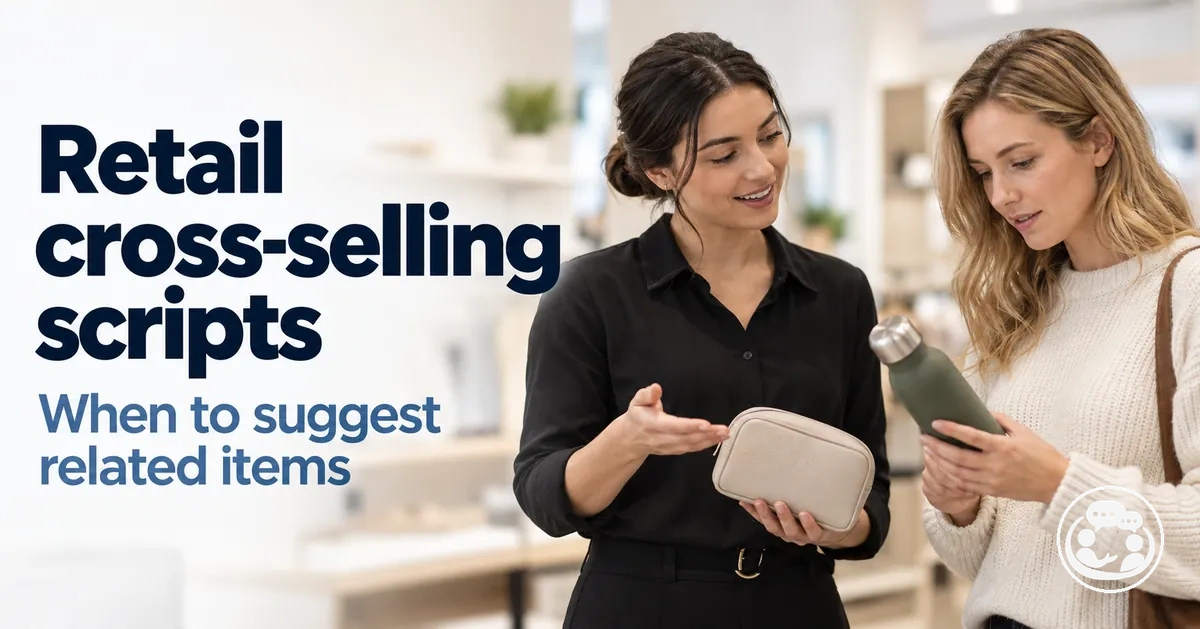
Should you suggest the related item now?
Answer these four checks from what the customer has actually said or done. The result shows whether the current conversation supports a suggestion, calls for waiting, or means the cross-sell should be omitted.
Table of Contents
When a Cross-Selling Suggestion Fits the Retail Conversation
A cross-selling suggestion fits when the customer need is sufficiently clear, the related item has an obvious functional connection to that need, and the timing does not interrupt the customer’s main decision.
The illustration clarifies how need clarity, product connection, and timing work together around one primary-item decision.
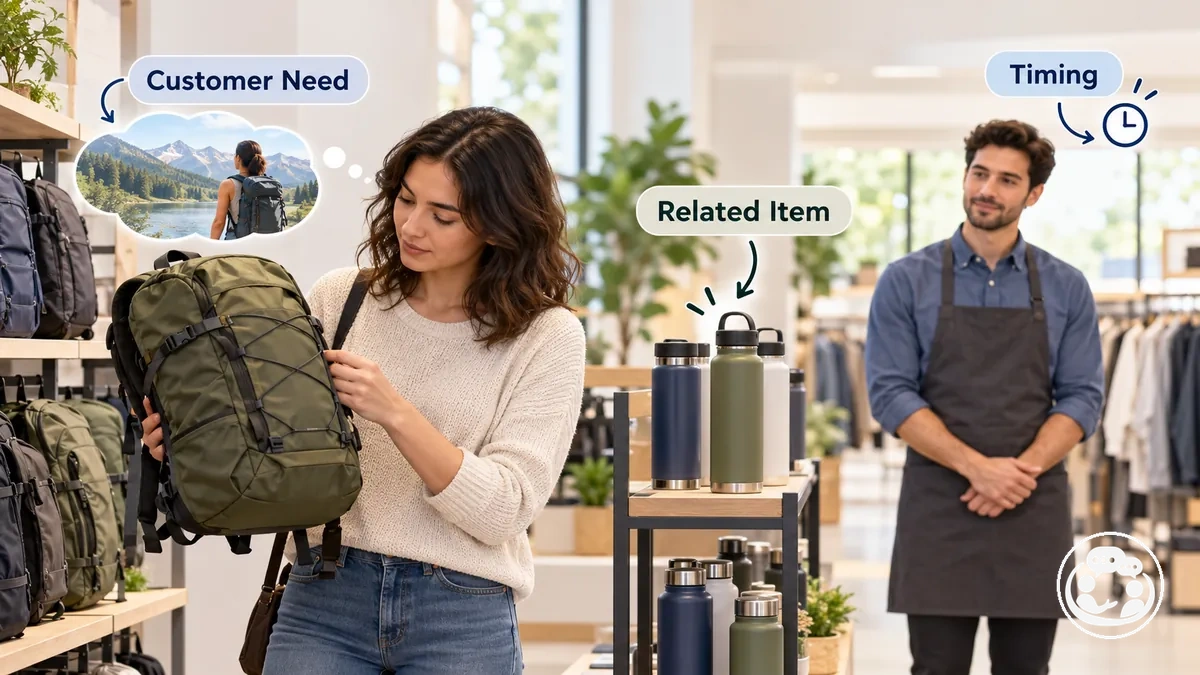
When all three conditions align, the relevance of the related item is easier for the customer to recognise and the suggestion is less likely to feel arbitrary or intrusive.
If the customer need remains unclear, the related item lacks a functional connection, or the timing interrupts the decision process, the fit is weaker and waiting is more appropriate.
This evaluation does not make every purchase an opportunity for cross-selling; it identifies whether the suggestion belongs in the current conversation.
The individual criteria can then be examined without turning the decision frame into a broader lesson on discovery, recommendations, or closing.
The Customer's Main Need Is Already Clear
The customer's main need should be clear enough to explain why they are considering the primary item before a related item is suggested.
The image illustrates observable need clarity through a stated goal or use case rather than a salesperson's assumption.
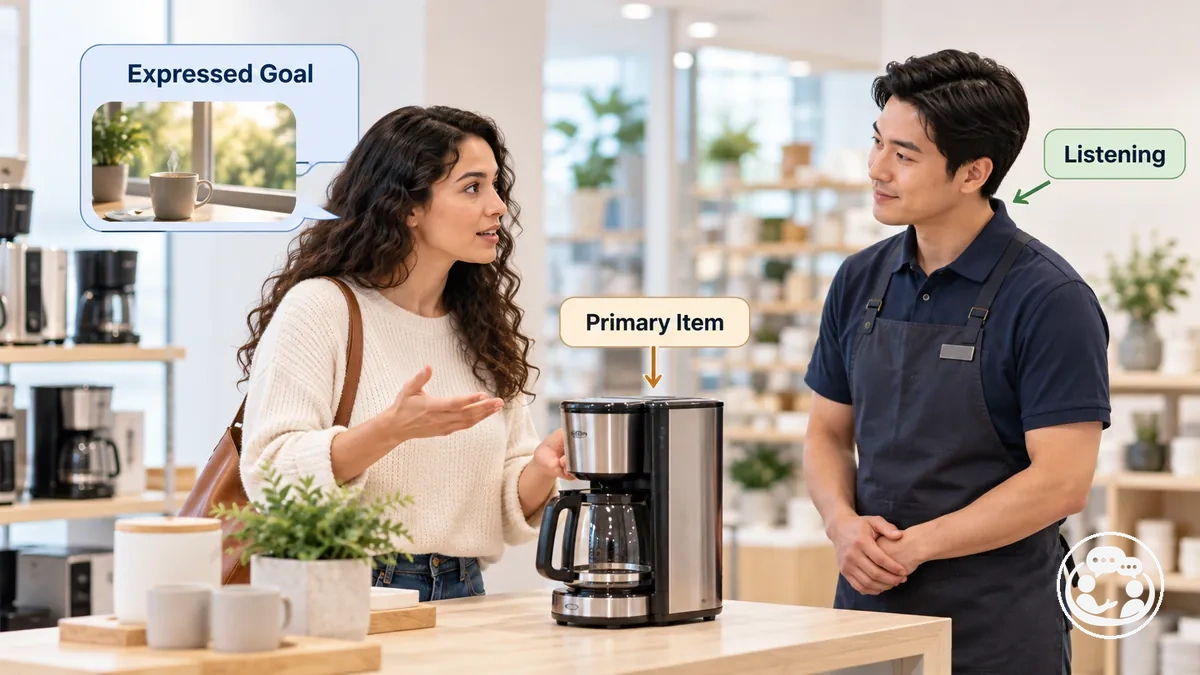
Need clarity comes from information the customer has expressed or confirmed, not from vague interest or assumptions.
These observable signals reduce guesswork and provide a stronger basis for judging the relevance of a related suggestion.
- Expressed goal: the customer states what they want the primary item to help them accomplish, giving the suggestion a defined use context.
- Stated constraint: the customer identifies a requirement or limitation that affects the primary choice, allowing relevance to be judged against that condition.
- Confirmed use case: the customer explains how or where the primary item will be used, providing a concrete basis for considering a connected need.
- Unresolved need: the reason for the primary choice remains ambiguous, so a related suggestion would rely more on assumption than confirmed information.
For example, if a customer says they need a laptop for frequent travel, that expressed goal gives enough context to consider a related item that supports portable use.
If the customer has only picked up the laptop without explaining an intended use or requirement, the main need remains uncertain and the salesperson should wait rather than guess.
Deeper work on understanding the customer's underlying needs belongs outside this subsection.
When need clarity is still weak, waiting for clearer information is more appropriate than treating an assumption as evidence.
The Related Item Solves a Connected Need
A related item belongs in a cross-sell only when it addresses a secondary need that is functionally connected to the customer's primary item and intended use.
The diagram illustrates how one complementary item can support the primary choice through a specific function and practical benefit.
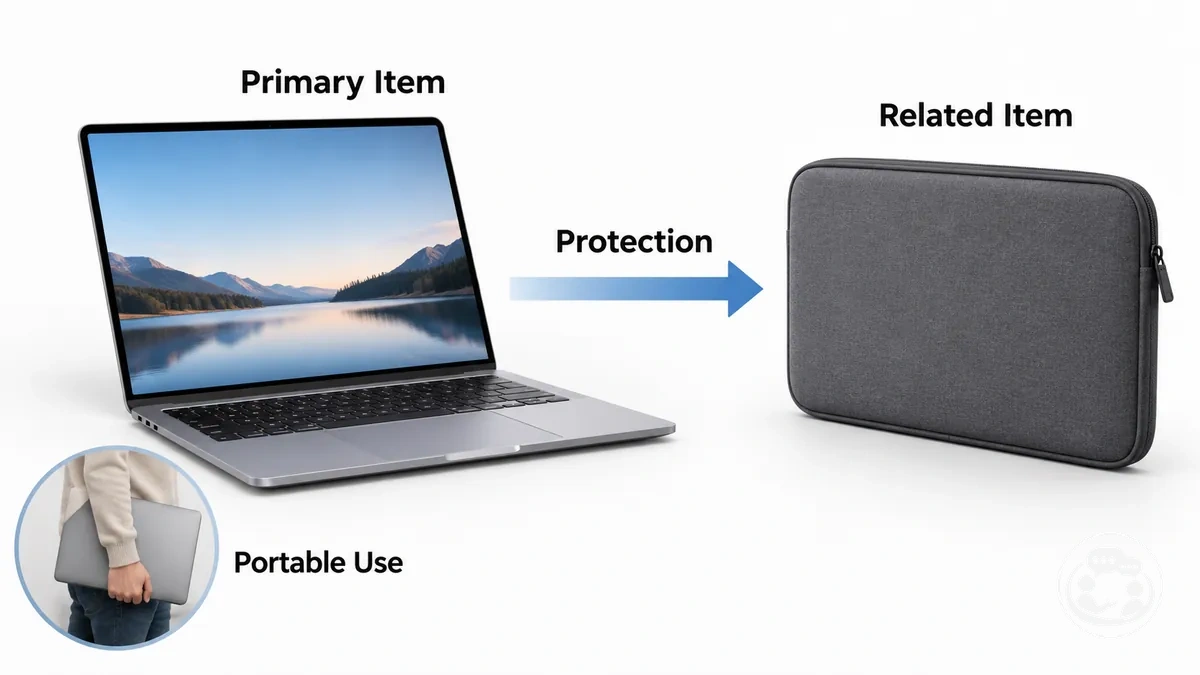
A genuine functional connection exists when the complementary item changes how the customer can use, protect, maintain, or complete the primary choice.
Compatibility is relevant only when the related item actually fits the required model, size, configuration, or use condition.
A product being displayed nearby or commonly bundled with the primary item does not by itself establish a connected need.
The main connection types can be judged by the practical implication for the customer's intended use:
- Protection: a correctly sized protective case can support a portable device when the customer needs protection during carrying or storage.
- Compatibility: a cable, adapter, or other complementary item can support the primary item when its required connection or configuration has been confirmed.
- Convenience: a related item can simplify the intended use when it addresses a specific task the customer has already identified.
- Maintenance: a suitable care or replacement item can support continued use when the primary item has a relevant maintenance requirement.
- Completion of use: a complementary item can be relevant when the customer's intended use cannot be completed in the chosen setup without that additional function.
The Timing Fits the Customer's Decision Stage
Cross-selling timing may be appropriate when the customer's main choice is sufficiently stable for an additional need to be considered without disrupting the decision.
The appropriate moment depends on the customer's decision stage rather than a fixed point such as checkout.
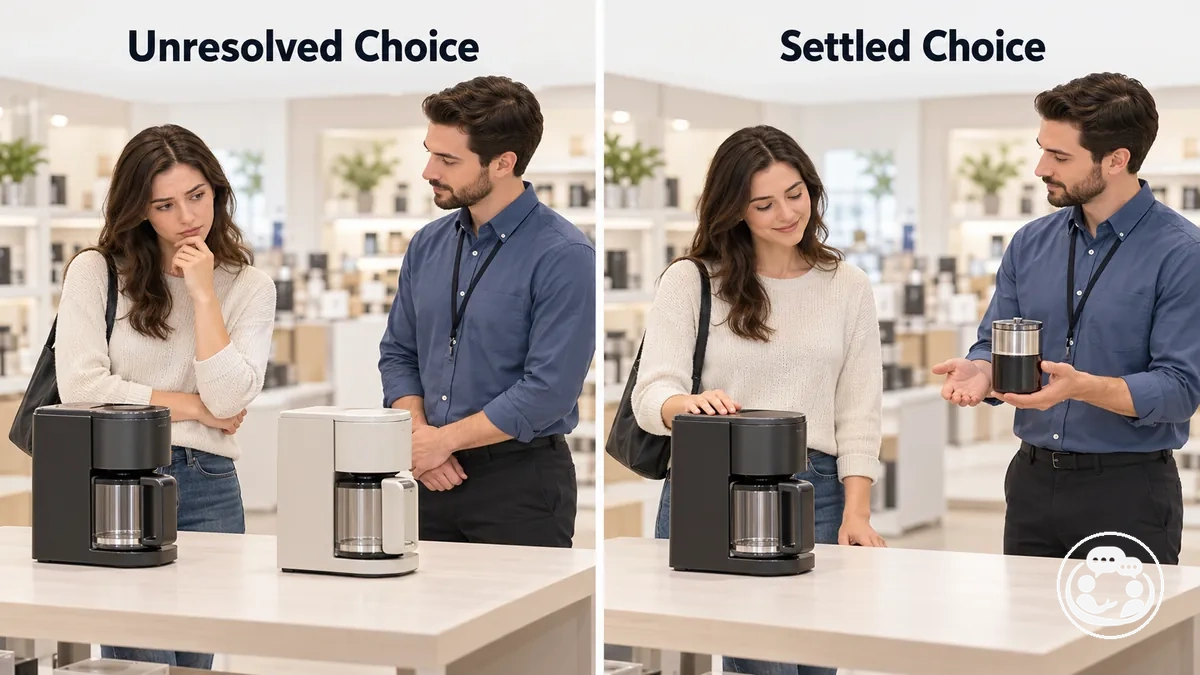
When unresolved uncertainty or active comparison remains around the main choice, introducing a related item can create an interruption and add another decision before the primary one is settled.
A settled choice instead suggests that the customer state may support considering an additional need, although it does not prove that the customer wants or will accept another item.
- Premature timing: the customer is still comparing the main item or expressing uncertainty, so a cross-selling suggestion can interrupt the current decision and increase cognitive load.
- Appropriate timing: the main choice appears sufficiently settled, so a relevant suggestion can complement that decision without redirecting attention from an unresolved comparison.
For example, suggesting a related item while a customer is still choosing between two main products may feel distracting, whereas the same suggestion after the customer has settled on one product may fit the conversation more naturally.
Even then, conversational timing remains conditional: a settled primary choice indicates a possible opening, not a guarantee that the customer needs or wants the related item.
This timing criterion ends with judging whether an additional suggestion fits the current decision state; techniques for asking for the sale belong to the separate closing process.
When to Hold Back From Cross-Selling
Hold back from cross-selling when relevance is uncertain, the customer's main decision remains unresolved, added suggestions may increase pressure, the customer has declined further help, or the related item does not fit the intended use.
In these situations, waiting or omitting the suggestion can protect the customer's focus and choice.

Relevance uncertainty, customer confusion, or repeated hesitation may indicate that another suggestion would add cognitive or financial pressure before the primary decision is clear.
An explicit refusal calls for stopping the suggestion, while a clear mismatch between an add-on and the customer's intended use does not support making it at all.
Silence, politeness, or time spent in the store does not by itself establish that another suggestion would be useful.
Each situation therefore calls for restraint based on what is observable in the current conversation.
- Unresolved need: if the customer is still working out what the primary item needs to accomplish, wait rather than introduce another product.
- Customer confusion: if the customer appears confused about the main options, pause the suggestion so the primary decision remains the focus.
- Repeated hesitation or pressure: if another choice may add cognitive or financial pressure while the customer is hesitating, hold back until the main decision is sufficiently clear.
- Explicit refusal: if the customer declines further suggestions or help, stop cross-selling and respect that choice.
- Mismatch with intended use: if a related item would not support how the customer intends to use the main product, do not make the suggestion; in this boundary case, restraint is the more useful sales response because the cross-sell would not improve the customer's outcome.
How to Connect a Cross-Sell to the Customer's Need
A need-linked cross-selling method turns an already identified customer need into one relevant complementary suggestion while preserving the customer’s choice.
- Start from the confirmed need Use the stated goal, intended use, preference, concern, or constraint that informed the main choice.
- Identify a connected secondary need Look for a need to support, use, protect, maintain, or complete the primary choice.
- Match one complementary item Choose an item whose function addresses that secondary need; confirm compatibility when model, size, configuration, or use condition matters.
- Confirm and offer without assuming Ask a narrow question if the secondary need is uncertain, then present the item as optional. A negative or uncertain answer ends that cross-sell.
Reference the Need the Customer Already Expressed
Reference only the customer wording that makes the related suggestion relevant, such as a stated goal, intended use, preference, concern, or constraint. Restate that detail accurately without adding a need the customer did not express.
Need-linked
You mentioned you’ll be travelling with it regularly, so this related option may be useful for that use.
The wording carries the customer’s stated use into the suggestion.
Too vague
You might also like this.
The wording introduces another item without explaining why it is relevant.
Carrying the stated need forward preserves continuity between the customer’s meaning and the related suggestion without restarting discovery.
Explain How the Related Item Complements the Main Choice
Explain the complementary function before asking the customer to consider the related item. Keep the explanation tied to the customer’s intended use so relevance comes from a functional connection rather than product features in isolation.
Select an attribute that changes usefulness, compatibility, protection, convenience, maintenance, or completeness of use, then translate it into a practical benefit. Where compatibility matters, verify suitability for the specific product, size, configuration, or use condition rather than assuming it.
Connected explanation
This related item can help protect the main item while you’re carrying it for the use you described.
Feature-only praise
This is a great add-on.
Praise alone does not state the complementary function or customer-relevant benefit.
Keep this step limited to why the related item is relevant to the main choice; broader product-recommendation technique belongs outside this cross-selling-specific explanation.
Ask a Brief Question to Confirm Relevance
Ask a brief question to confirm relevance before presenting the related item as useful, checking whether the suspected secondary need actually applies.
The confirming question should be narrow, need-specific, and genuinely open to a negative customer answer rather than restarting broader needs discovery.
- Intended use: “Will you be using it in that situation as well?”
- Protection: “Will you need something to protect it while carrying it?”
- Convenience: “Would having that available with the main item be useful for how you plan to use it?”
A positive answer supports explaining the related item as an optional suggestion because the secondary need has been confirmed; a negative answer means that need does not apply.
A negative or uncertain answer should end that cross-sell rather than trigger more probing in the same moment.
Present the Option Without Assuming Agreement
Present the related item as an option the customer can accept or decline without pressure, rather than as an assumed addition to the main purchase. Neutral wording leaves room to decline without needing to justify the decision.
Optional
If that would be useful for how you plan to use it, this related item is an option.
The decision remains with the customer.
Assumptive
I’ll add this related item for you as well.
The wording presumes agreement and can create pressure.
Retail Cross-Selling Dialogue Examples
Retail cross-selling dialogue should change with the customer need, timing, relevance, and the customer’s choice rather than rely on fixed wording. These examples show how the response changes when a related item is accepted, declined, or not yet appropriate to suggest.
Accepted
- Context
- The customer has chosen a primary item and confirmed a related secondary need.
- Salesperson
Since you’ll be carrying it regularly, this protective case is an optional suggestion if that would be useful.
- Customer
Yes, that would help.
- Adaptation
- Continue with the relevant related item without adding unrelated suggestions.
Declined
- Context
- The timing is appropriate and the related item is relevant, but the customer does not want it.
- Salesperson
If you’d like something to keep those together, this organiser is an option.
- Customer
No thanks, I’ll just take the main item.
- Adaptation
- Acknowledge the decline and stop the cross-sell:
No problem, we’ll stay with your main purchase.
Not yet appropriate
- Context
- The customer is still uncertain about which primary item fits the intended use.
- Salesperson
Let’s work out which of these suits what you need first.
- Customer
I’m still deciding between them.
- Adaptation
- Wait and make no related-item suggestion because the timing and relevance of an additional item are not yet established.
The reusable rule is to adapt the wording to the customer’s current condition: offer a related item when need and timing support it, stop after a decline, and withhold the suggestion when relevance is unresolved. The wording can change while the need-linked, choice-preserving method remains consistent.
Cross-Selling Mistakes That Make Suggestions Feel Pushy
A cross-selling mistake can create pressure when relevance, timing, quantity, or customer choice breaks down.
Common problems include an irrelevant suggestion, poor timing, too many add-ons, ignoring a refusal, and focusing on the sale instead of the customer need.
The table separates each observable mistake from why it may feel pushy, its recognition cue, and the corrective direction.
This makes the behaviour easier to diagnose without treating every customer decline as evidence of a weak cross-sell.
| Mistake | Why It Feels Pushy | Recognition Cue | Corrective Direction |
|---|---|---|---|
| Irrelevant suggestion | The related item has no clear connection to the customer need, so the suggestion may appear driven by the sale rather than usefulness. | The salesperson cannot explain how the item relates to the customer's stated goal, intended use, or constraint. | Correct by withholding the suggestion unless a relevant connection to the customer need can be established. |
| Poor timing | An additional suggestion can interrupt the primary decision and create pressure when the customer is still uncertain. | The customer is still comparing, asking questions about, or hesitating over the main item. | Wait until the primary decision is sufficiently settled before considering a related item. |
| Too many add-ons | Multiple additional choices may increase cognitive load and shift attention away from the customer's main purchase. | The salesperson introduces several add-ons instead of one relevant option tied to the identified need. | Use restraint and present one relevant option rather than stacking unrelated or weakly related suggestions. |
| Ignoring a refusal | Continuing the same suggestion after an explicit refusal disregards customer choice and creates direct pressure. | The customer says no, but the salesperson repeats, reframes, or continues pressing the same add-on. | Acknowledge the refusal, stop that suggestion, and return attention to the main purchase. |
| Sale-first framing | Emphasising the additional sale instead of the customer need can make the suggestion feel disconnected from the customer's purpose. | The wording focuses on adding another product without explaining why it is relevant to the customer's intended use. | Correct by linking any related item to an identified need and presenting it as an optional choice. |
A customer declining a relevant, well-timed optional item does not by itself mean the cross-sell was poor.
A weak cross-sell is recognisable through problems such as poor relevance, poor timing, excessive add-ons, or failure to respect customer choice; a simple decline is a valid customer response.
Cross-Selling vs Upselling in Retail Conversations
Cross-selling adds a complementary item to the customer's main choice, while upselling changes the main choice by moving the customer toward an upgrade or higher-tier option.
Both are related retail sales techniques, but the comparison basis differs in what part of the customer's choice is being changed.
The comparison below uses the same dimensions to prevent terminology confusion: what changes, how the offer relates to the main choice, the typical wording logic, and the suitable context.
The distinction is practical rather than a ranking of one approach over the other.
| Approach | What Changes | Relation to Main Choice | Typical Wording Logic | Suitable Context |
|---|---|---|---|---|
| Cross-selling | An additional complementary item is introduced while the main choice remains the same. | The related item complements a separate need connected to the main choice. | Connect the related item to an identified customer need and present it as optional. | After relevance and timing support an additional suggestion; for example, offering a compatible protective case after the customer chooses the main item. |
| Upselling | The main choice changes to an upgrade, larger version, or higher-tier option. | The suggested option is an alternative version of the main choice rather than a separate complementary item. | Explain the relevant difference between the current choice and the upgraded option without assuming the customer should change. | When a higher-tier option has an attribute relevant to the customer's stated need; for example, comparing the selected model with an upgraded version that provides that attribute. |
The boundary depends on what the suggestion changes.
If the retail example adds a complementary item while preserving the original main choice, it is cross-selling; if it moves the customer from that main choice to a higher-tier or upgraded alternative, it is upselling.