
How to Use Retail Sales Scripts for Needs-Based Product Recommendations
A needs-based retail product recommendation starts with the shopper's stated priority: turn that need into a product criterion, match it to a relevant feature or capability, explain the benefit in the shopper's context, then confirm or adjust the fit from the shopper's response. Present the strongest fit first, and add a second option only when it clarifies a meaningful trade-off.

Needs-based recommendation flow
Keep the reasoning traceable from the shopper's words to the recommendation and back to the shopper's response.
- NeedIdentify the stated purpose, requirement, preference, constraint, or trade-off.
- CriterionTranslate the need into the product attribute or capability that determines suitability.
- Fit reasonConnect a factual feature or capability to its functional effect and customer-relevant benefit.
- Option orderRecommend the strongest fit first; use a second option only to clarify a relevant difference or trade-off.
- Confirm or adjustUse the shopper's feedback to verify the priority and constraints, then retain or revise the recommendation.
“Because you said [priority need], I'd start with [option]. Its [feature or capability] means [functional effect], which may help with [customer benefit] in your situation. How does that fit what matters most to you?”
If the shopper reveals a new priority or constraint, reassess the criteria before keeping the recommendation.
Start by translating the shopper's stated need into criteria that can distinguish suitable options.
Table of Contents
Translate Discovered Customer Needs Into Product Criteria
Customer-derived product criteria translate an already-discovered customer need or constraint into something that can guide product selection.
Each customer statement should map to a relevant product attribute or capability, an acceptable condition, and an implication for fit.
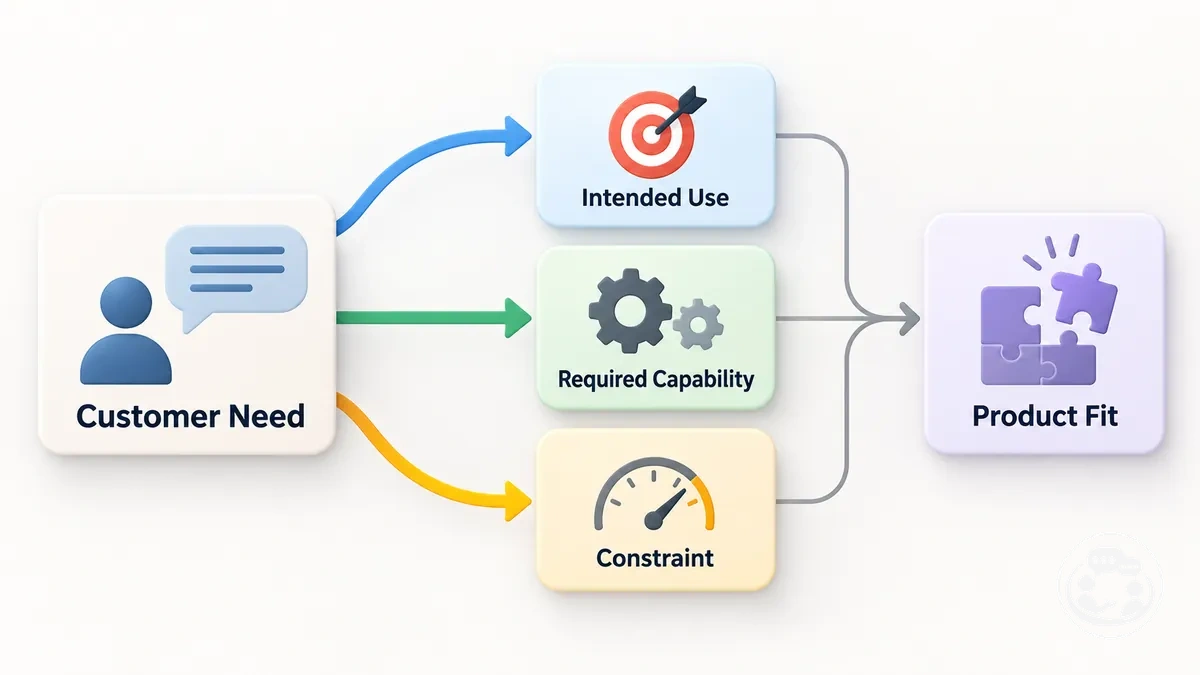
Intended use identifies what the product must support, while a requirement defines a capability or condition that needs to be present for the option to remain suitable.
A preference can guide selection without automatically determining fit, while a constraint limits which conditions are acceptable and a trade-off identifies what the shopper may accept to gain another benefit.
These criteria come from needs identified through finding out what a customer needs earlier in the conversation, rather than from generic assumptions about the shopper.
The resulting criteria provide the decision-relevant dimensions for assessing product fit.
- Intended use: Map what the shopper plans to do to the product attribute or capability needed for that use; an option is relevant when its capability supports that stated purpose.
- Requirement: Convert a stated need into a product criterion that the option needs to satisfy; an option that does not meet that condition may not fit the shopper's requirement.
- Preference: Connect a desired characteristic to the corresponding product attribute; it can influence the recommendation when that characteristic matters to the shopper.
- Constraint: Translate a limit stated by the shopper into an acceptable condition for the relevant product attribute or capability; options outside that condition become less suitable for the stated need.
- Trade-off: Identify which product attribute the shopper may accept less of in exchange for another capability or benefit that matters more in the current context.
For example, a product attribute such as compact size can be important when the shopper needs easy storage or portability, but it may carry little weight when space is not a constraint.
The attribute therefore becomes a meaningful product criterion because of the customer's context, not because it has the same priority for every recommendation.
Separate Must-Haves From Preferences
A must-have is a requirement or constraint the shopper has expressed as necessary for fit, so an option that fails that criterion may no longer be viable.
A preference allows more flexibility because the shopper may accept a trade-off without making the option unsuitable.
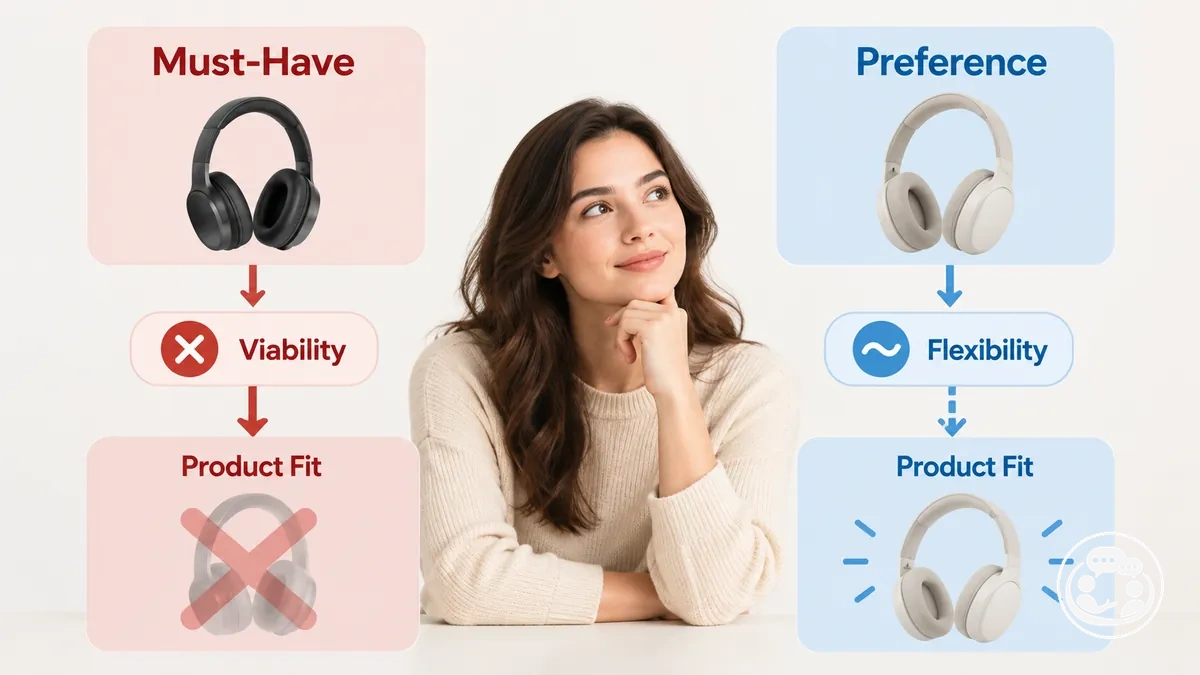
Key distinction
Must-have
State: non-negotiable requirement or constraint.
Fit implication: an option that does not satisfy it may no longer be viable for the stated need.
Preference
State: flexible desired characteristic.
Fit implication: alternatives and trade-offs remain possible, so an option may still be suitable without fully matching it.
The same product attribute can therefore be a must-have for one shopper and a preference for another, depending on the customer's statement.
For example, a functional capability needed for the shopper's intended use can determine whether an option remains viable, while a preferred characteristic can flex if the shopper accepts the trade-off.
This classification leaves the criteria ready for priority weighting without assuming that every preference has equal importance.
Prioritize the Need That Should Drive the Recommendation
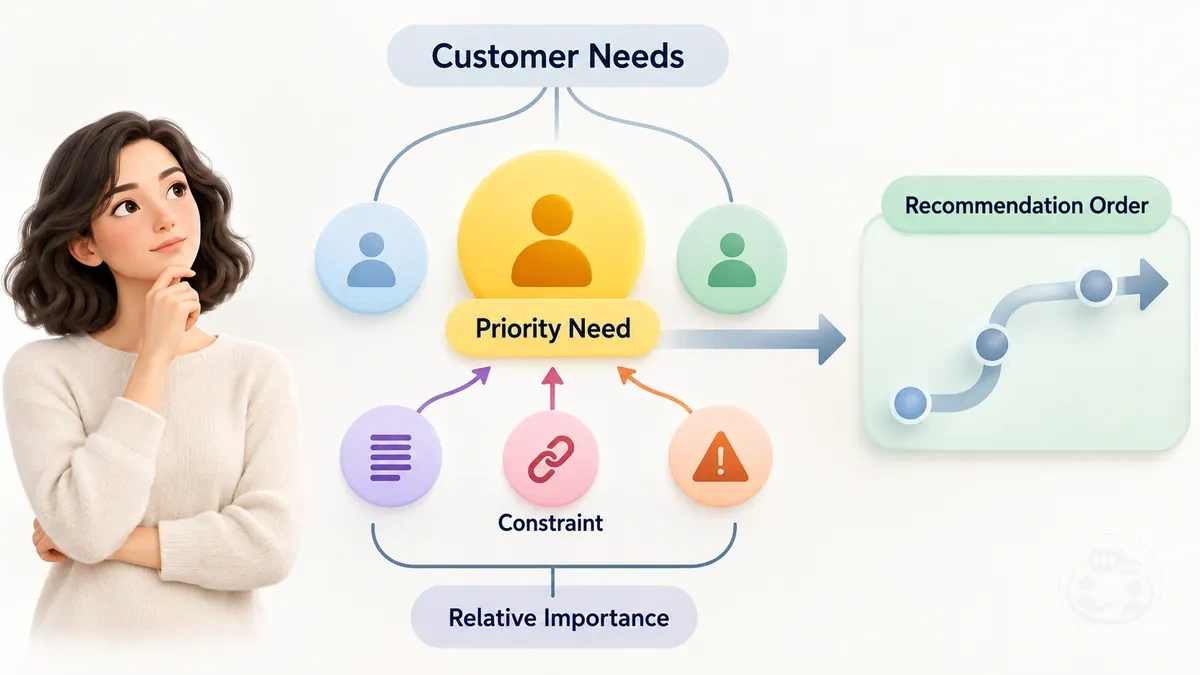
The priority need is normally the criterion whose failure would most materially undermine suitability, based on the shopper's stated purpose, constraint, and emphasis.
When several criteria compete, their relative importance should come from the customer statement and the consequence of mismatch rather than from seller preference.
Explain Why a Product Fits the Customer
Product fit is established when a relevant product capability addresses the customer need the shopper has stated under the conditions that matter to their situation.
The recommendation reason should therefore connect that need to a specific capability and explain why its functional effect is relevant to the shopper.

Fit is the complete connection between the customer need, relevant capability, functional effect, and customer-relevant benefit—not generic product praise.
Example
Need: easy storage in limited space.
Capability: a compact product form.
Practical interpretation: the smaller stored form may make the product easier to accommodate in the shopper's available space.
Lead With the Customer Need the Recommendation Addresses
Begin the recommendation by acknowledging the specific customer need or stated priority the shopper has already expressed.
Restate that meaning accurately, then introduce the product without implying agreement or adding a need the shopper did not state.

Adaptable example
Acknowledge the customer need, make the recommendation statement, then connect a relevant feature to the reason for fit.
- Shopper
- “I need something that is easy to store.”
- Associate
- “Since easy storage is your stated priority, this product is worth considering because its compact form may suit the space you described.”
The wording can adapt to the conversation, but the reason for fit should remain tied to what the shopper actually said.
Translate Product Features Into Customer-Relevant Benefits
A product feature describes a characteristic, attribute, or functionality the product has or provides, while a customer benefit explains the useful effect for this shopper.
The translation becomes relevant when the feature produces a functional effect that addresses a specific customer need under the conditions in which the shopper expects to use the product.
Translate each factual product feature by identifying its functional effect first, then explain the practical customer benefit and the condition that makes it meaningful.
The examples below map product facts to their functional effects and customer relevance, while keeping each benefit conditional on the shopper's circumstances.
| Product feature | Functional effect | Customer-relevant benefit |
|---|---|---|
| Compact form | Occupies less storage space | May suit a shopper whose customer need is easier storage in limited space |
| Adjustable component | Allows the product configuration to be changed | May provide useful flexibility when the shopper needs the product to accommodate different use conditions |
| Built-in handle | Provides a dedicated point for carrying the product | May make handling more practical when portability is relevant to the shopper |
Keep Benefit Explanations Specific Without Overselling
Overselling occurs when a benefit claim goes beyond the evidence provided by the product attribute or ignores the customer condition that determines its relevance.
Keep each specific benefit within that support by stating the observable or practical effect and any limitation that matters to the shopper's stated need.
Use qualified, need-specific wording when the benefit depends on how or where the product will be used.
A supportable claim connects the product attribute to a relevant customer condition rather than presenting a possible benefit as a certain outcome.
The contrast below shows how an inflated claim can become a bounded benefit statement.
- Overstated: “This compact product will solve your storage problems.”
- Corrected: “Its compact form may make it easier to store if limited space is your main constraint.”
Present One or Two Suitable Product Options Clearly
Present the strongest fit first, based on the shopper's customer criteria and stated priority.
Add a second option only when it also has suitable relevance and helps clarify a meaningful difference or trade-off; if one option clearly meets the requirement, do not force another choice.
Keep the presentation order short so the shopper can understand why each option is being considered.
Use the following sequence to distinguish the first option from an optional alternative without turning the recommendation into a catalogue.
- Present the first option: Identify the option that appears to provide the strongest fit for the priority criterion and give a concise rationale tied to that criterion.
- Add a second option only when useful: Introduce an alternative when it also meets the relevant customer criteria but offers a trade-off that may suit a different condition or preference.
- State the meaningful difference: Compare only the one or two attributes that affect the shopper's choice, explaining how each difference changes suitability for the stated need.
Limit the comparison to differences connected to the customer's criteria rather than introducing unrelated products or attributes.
One clearly suitable option can provide better choice clarity than unnecessary alternatives, while two options are useful when their meaningful difference helps the shopper understand the relevant trade-off.
Recommend the Strongest Fit First
The first recommendation should normally be the product option that provides the strongest fit for the shopper's highest-priority criteria with the fewest material compromises.
Its suitability should reflect the established customer priority rather than seller preference or unrelated product attributes.
Strongest-fit decision
- Priority fit
- Assess how closely each suitable option satisfies the shopper's highest-priority criterion.
- Material compromise
- Account for compromises that affect the stated use or constraint; when several options fit, the one with fewer material compromises may lead.
- Placement rule
- Recommend the strongest-fit option first, while keeping the explanation conditional on the criteria actually established with the shopper.
Compare a Second Option by the Relevant Trade-Off
A second option is useful when it also satisfies the shopper's must-haves but differs on an attribute the shopper has said matters.
Compare the options on the same customer-relevant criteria so the shopper can see what is gained, what is given up, and which difference matters more.
Meaningful two-option comparison
Option 1: priority-led fit
Lead with the option that better satisfies the shopper's highest-priority criterion with fewer material compromises.
Option 2: relevant alternative
Present it only when a different customer-relevant attribute or trade-off gives the shopper a meaningful reason to consider it.
Decision cue: let the shopper's stated priority and accepted trade-off determine which option remains the stronger fit.
Do not add a second option merely to create choice. If it does not clarify a relevant trade-off, keep one clear recommendation.
Confirm the Product Recommendation Fits the Customer's Needs
Product fit should be verified from the shopper response after the recommendation is presented, not inferred from silence, politeness, or a lack of immediate objection.
The verification should check whether the recommendation still aligns with the customer priority and any relevant constraint.
Use a short sequence to connect the stated priority to the shopper's feedback and interpret whether suitability has been confirmed or changed.
Each step has a specific purpose and keeps any adjustment tied to information the shopper actually provides.
- Restate the customer priority: Briefly acknowledge the need or constraint the recommendation is intended to address so the basis for verification remains explicit.
- Invite the shopper's reaction: Ask an adaptable confirmation question about how the option fits that priority rather than assuming agreement from silence or politeness.
- Identify confirmation or mismatch: Interpret what the shopper actually says, noting whether the relevant condition remains satisfied or whether new information reveals a mismatch affecting product fit.
- Retain or revise the recommendation: Keep the recommendation when the shopper response supports its suitability, or revise it when a changed priority, constraint, or other relevant information requires an adjustment.
A recommendation can be retained when explicit customer feedback remains consistent with the priority it was designed to address.
When the response introduces uncertainty or a material mismatch, revise the recommendation according to the new information rather than treating the original product fit as settled.
Verify the Recommendation Against the Customer's Priority
Verify the recommendation against the shopper's established priority requirement rather than whether they generally like the product.
Evidence of fit should show that the option satisfies that requirement under the relevant constraint, while a positive preference alone does not establish suitability.
Use the customer response to evaluate whether the priority requirement is still satisfied and identify any uncertainty that remains.
Confirmation is appropriate when the shopper's feedback supports the required fit conditions; a mismatch or unresolved condition indicates a need for adjustment without predetermining what that adjustment should be.
When several conditions affect the priority requirement, check them directly:
- Priority requirement: Check that the recommendation still addresses the specific requirement the shopper identified as most important.
- Relevant constraint: Verify that any established constraint affecting the priority requirement remains satisfied.
- Evidence of fit: Use what the shopper actually confirms or clarifies to assess suitability rather than treating general liking as confirmation.
- Remaining uncertainty: Identify any unresolved condition or incomplete customer response that prevents a confident fit conclusion.
- Verification outcome: Treat the fit as confirmed when the relevant conditions are supported; otherwise, identify a clear need for adjustment.
Adjust the Recommendation When New Information Changes the Fit
New information from the shopper can change a relevant criterion and therefore change which recommendation is suitable.
When a changed priority or new constraint affects the original reasoning, acknowledge the correction and reassess the current option rather than defending the recommendation.
Keep the adjustment focused on the condition that changed and how it affects the current product fit.
Use the new information as the reason for each revision:
- Acknowledge the new information: Recognize the shopper's correction, changed priority, or new constraint so the reason for reassessment is explicit.
- Update the relevant criterion: Revise the requirement or condition affected by the customer's statement without introducing unrelated criteria.
- Reassess the current option: Check whether the product still satisfies the updated criterion and identify whether its suitability is weakened, removed, or largely unchanged.
- Present the revised fit: Revise the recommendation direction when needed and explain how the updated option relates to the changed condition.
A changed need calls for recommendation adjustment, while a separate customer concern about an otherwise suitable recommendation is a different issue.
In that case, responding to concerns about recommendations belongs to objection handling rather than further changing the customer's criteria.
Common Retail Product Recommendation Mistakes
A recommendation mistake matters when it weakens the connection between the customer need and the product being presented, obscures why the option is relevant, or increases the risk of a mismatch.
In associate-led retail conversations, these mistakes can also make the recommendation feel confusing or pushy when the reasoning is not clearly tied to what the shopper has said.
The most useful way to recognise these errors is to identify the behaviour, its likely consequence, the recognition cue that signals it, and the shortest corrective direction:
Mistake → cue → correction
Recommending before understanding the need
Why it matters: selecting a product before the important requirement is clear can create a mismatch.
Cue: you cannot connect the suitability explanation to a stated customer need.
Correction: establish the relevant need before recommending an option.
Over-weighting a weak preference
Why it matters: a casual preference can displace a stronger priority or constraint.
Cue: a minor preference is outweighing a requirement the shopper identified as more important.
Correction: keep the established priority central unless the shopper provides new information.
Feature dumping
Why it matters: a list of specifications can obscure why the recommendation fits.
Cue: several features are described without explaining their relevance to the customer need.
Correction: focus on features that support the stated requirement and explain their customer-relevant benefit.
Using an overstated benefit
Why it matters: a claim stronger than the product information or customer context supports can imply suitability that has not been established.
Cue: the wording promises an outcome instead of explaining how a relevant feature may help.
Correction: state the benefit specifically and qualify it for the shopper's situation.
Presenting too many options
Why it matters: unnecessary alternatives make the differences between suitable products harder to interpret.
Cue: several options are presented without a clear reason each deserves consideration.
Correction: narrow the choice to the strongest relevant options and make the meaningful trade-off clear.
Skipping fit verification
Why it matters: the recommendation remains uncertain if it is never checked against the shopper's stated priority.
Cue: the conversation moves on without using the shopper's response to check for a mismatch or changed constraint.
Correction: verify fit against the established priority before treating the recommendation as suitable.
These retail product recommendation mistakes share a common pattern: the associate's reasoning becomes disconnected from the shopper's stated need, priority, or response.
Correcting that disconnect keeps the conversation focused on relevance, clarity, and customer-product fit without re-teaching the full recommendation process.
Retail Product Recommendation Dialogue Examples
Retail product recommendation dialogue should demonstrate adaptable reasoning rather than wording to memorise.
Each example connects the customer need to a recommendation reason, relevant benefit, shopper response, and fit confirmation while adapting the language to the situation.
Scenario: one strongest-fit option
- Customer
- “I need something compact because storage space is limited.”
- Associate
- “This option fits that need because its smaller form takes up less storage space.”
- Customer
- “That sounds suitable for the space I have.”
- Associate
- “Then the compact size supports the product fit you described.”
Transferable principle: keep the recommendation reason and benefit tied to the shopper's strongest requirement.
Scenario: a relevant trade-off
- Customer
- “I need something easy to store, but I would also prefer the larger capacity.”
- Associate
- “This option is the stronger fit for storage, while the second option gives you more capacity but takes up more space.”
- Customer
- “Storage matters more, so I would rather keep the smaller option.”
- Associate
- “That confirms the first option fits your higher-priority need.”
Transferable principle: a clear trade-off between two suitable options can support fit confirmation without presenting unnecessary choices.
Scenario: new information changes the fit
- Customer
- “I just realised it also needs to fit in a narrower space than I mentioned.”
- Associate
- “That new information changes the fit, so I would reassess the first option against that constraint.”
- Customer
- “Yes, the narrower space is essential.”
- Associate
- “In that case, my revised recommendation would be the option that meets the narrower-space requirement.”
Transferable principle: adjust the recommendation when changed information alters the criterion that determines suitability.
This recommendation exchange remains one part of the broader retail sales scripts from greeting to closing.