
How to Greet Retail Customers Naturally
Greet retail customers with a brief, warm acknowledgement, then give them room to orient before increasing engagement. Match the next step to the shopper’s observable readiness: stay available during focused browsing, respond proportionally when they engage, and step back when they signal a preference for space.

Retail greeting decision guide
Use the shopper’s current behaviour—not a fixed countdown—to choose the level of engagement. No single cue proves intent; combine orientation, attention, and response before adjusting your approach.
- Just entered or still orienting
- Best next move: acknowledge briefly, keep the shopper’s path open, and allow time to scan the store.
- Browsing with neutral or ambiguous cues
- Best next move: remain visibly available; make help optional and pause instead of stacking questions.
- Opens the interaction
- Best next move: respond to what the customer has volunteered and continue only as far as their response supports.
- Signals a preference for space
- Best next move: release pressure, step back, and stay available without repeating the offer immediately.
Core sequence: acknowledge → open warmly → offer help optionally → pause → adjust to the response.
Table of Contents
When to Approach a Retail Customer
Approach timing for a retail customer should depend on whether the shopper has had time to orient and shows reasonable readiness to interact, not on a rigid countdown.
The appropriate moment changes with the shopper's attention, position, line of sight, and response to the associate's presence.
The main criteria are observable conditions that help distinguish whether to approach, acknowledge from a distance, or give more space.
No single cue proves readiness, so the associate should consider the shopper's orientation and willingness to engage together.
The image illustrates these orientation and readiness conditions without treating either as definitive.
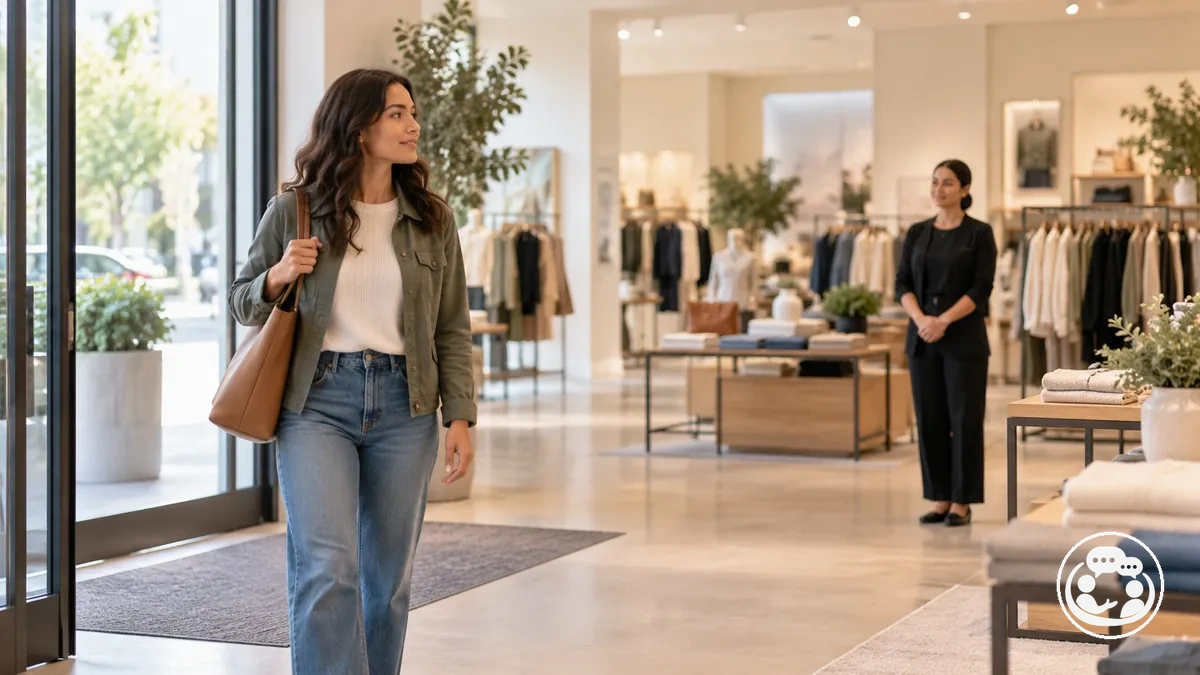
- Entering and orienting: If the shopper has just entered and is looking around to understand the store, give them space to settle rather than approaching immediately.
- Clear line of sight: If the shopper and associate can see each other while the shopper remains focused on the store, a brief acknowledgement from a distance may be appropriate without requiring fuller engagement.
- Focused attention: If the shopper is concentrating on products, signs, or their surroundings and does not redirect attention toward the associate, allow more space.
- Attention shifts toward the associate: If the shopper looks toward the associate and appears receptive to interaction, that condition supports a closer approach.
- Active willingness to engage: If the shopper responds to acknowledgement, initiates contact, or otherwise invites interaction, approaching is more strongly supported than when those cues are absent.
No single waiting time or fixed distance is a universal rule. Store layout, traffic, shopper orientation, and the customer’s response determine whether the appropriate next step is acknowledgement, a closer approach, or more space.
An approach can be too immediate while a shopper is still orienting, appropriately timed when attention opens toward interaction, or unnecessarily delayed when the shopper is clearly seeking engagement.
Give the Customer Time to Enter and Orient
Give the customer a brief opportunity to enter and orient before beginning fuller engagement.
Visual scanning of shelves or signage can show that the shopper is still registering the store environment, while entrance congestion or an open pathway can affect how much space is practical.
A simple acknowledgement can welcome the customer without turning their arrival into an immediate approach.

For example, a customer entering a busy store may pause for visual scanning, then move purposefully toward a display and settle into browsing.
The associate can notice the arrival, offer a brief acknowledgement when appropriate, allow the customer to orient, and approach when the immediate conditions support fuller interaction.
This separates immediate acknowledgement from immediate full engagement without prescribing the same waiting period for every shopper.
Adjust the Approach to the Customer's Readiness to Engage
Early customer cues can guide greeting adjustment by suggesting how ready the shopper may be for interaction, but they do not prove purchase intent.
Eye contact, body orientation, a pause near staff, or an apparent search for assistance may support a more direct approach, while sustained browsing can call for less interruption.
Each cue remains context-dependent, so greeting intensity should reflect the overall situation rather than one gesture.
The useful distinction is between cues suggesting openness, ambiguous or neutral browsing, and cues suggesting a preference for more space.
These states describe possible readiness to engage and support different levels of acknowledgement or approach rather than a fixed classification.
The image illustrates observable behaviour and possible response intensity without treating either as a certain interpretation.
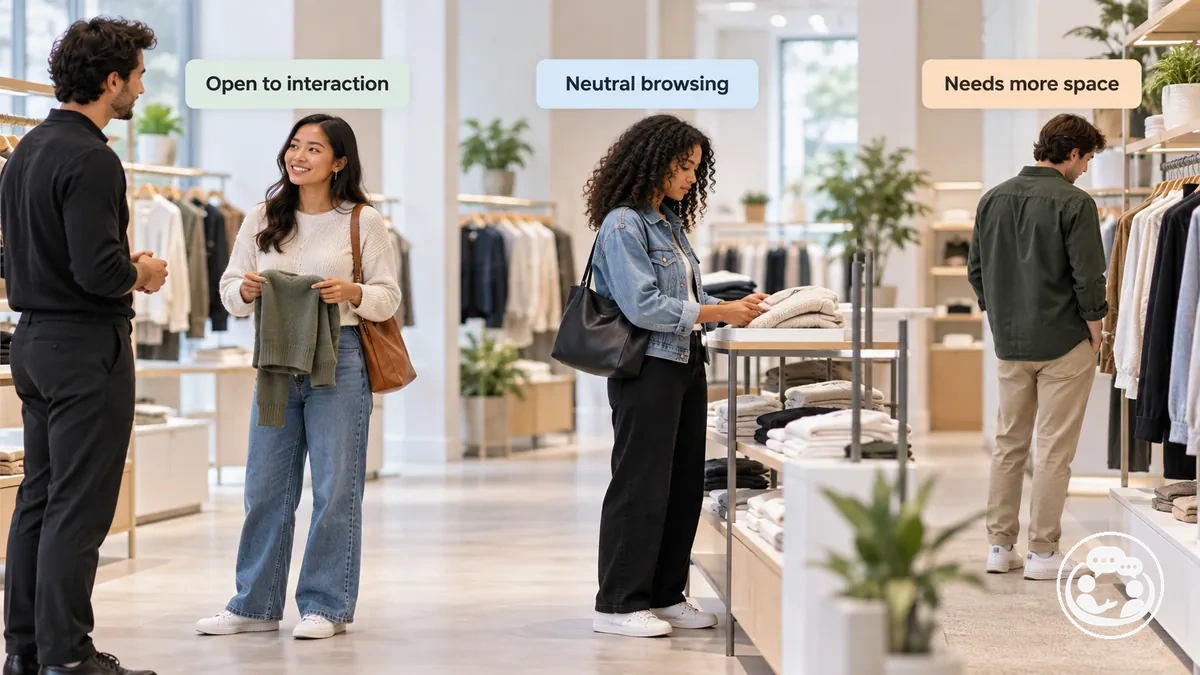
- Cues suggesting openness: Eye contact combined with body orientation toward the associate, a pause near staff, or a visible search for assistance may indicate openness to interaction and support a more direct greeting or approach.
- Ambiguous or neutral cues: A shopper browsing at an unhurried pace without clearly directing attention toward or away from staff may be comfortable with a brief acknowledgement while the associate remains available.
- Cues suggesting more space: Sustained focused browsing with body orientation toward merchandise and little attention directed toward staff may suggest that a lower-intensity greeting and more space are appropriate at that moment.
How to Open a Retail Greeting Without Pressure
A low-pressure retail greeting follows a simple sequence: acknowledgement, a friendly opening, an optional offer of help, then a pause that leaves the customer free to respond or continue browsing.
The wording should stay brief and assistance should remain available without requiring an immediate decision.
Wording, tone, and pace influence how the opening may be received, while the pause after an offer of help preserves customer choice.
A low-pressure opening makes assistance available and allows space for a response; a stacked or demanding opening can place several questions or requests on the shopper before they have chosen to engage.
The sequence keeps each action distinct rather than turning the greeting into an immediate conversation.
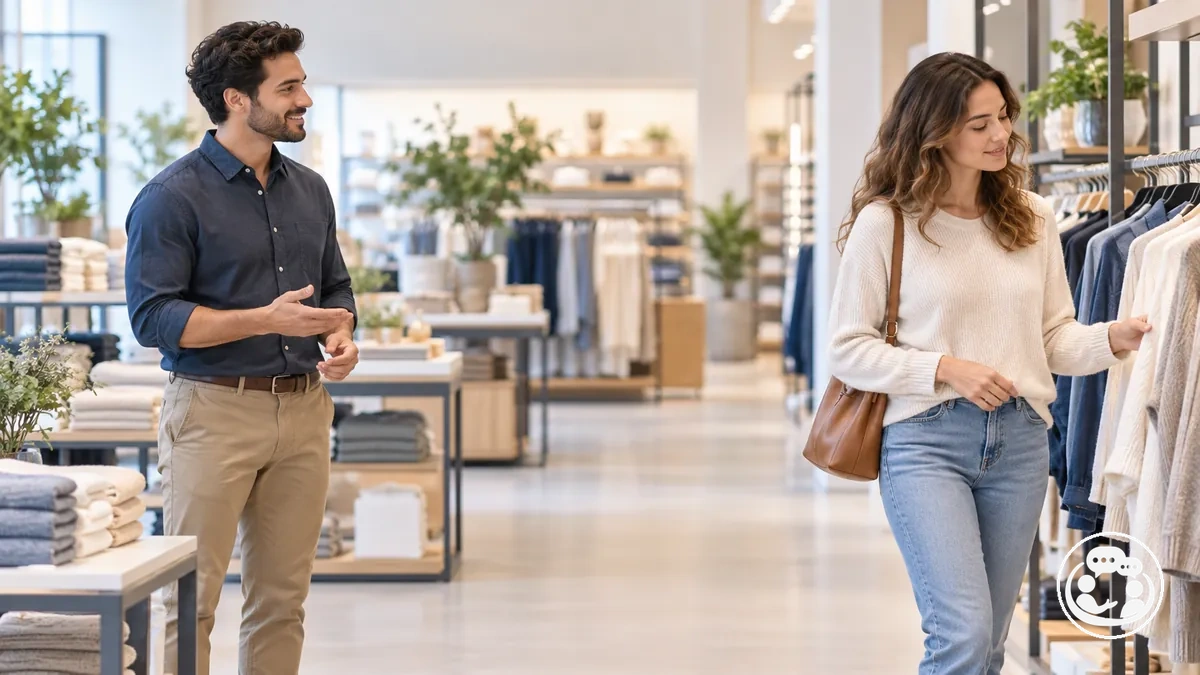
- Acknowledge: Recognise the customer with a brief, warm acknowledgement.
- Open warmly: Use a friendly opening that suits the store and situation.
- Offer help optionally: Make assistance available without requiring the customer to accept it immediately.
- Pause: Allow the shopper time and space to respond or continue browsing.
Adaptable wording might include “Hi, welcome in,” “Good morning, let me know if I can help,” or “Feel free to have a look around; I’m here if you need anything.” The exact phrase, tone, and pace can be adjusted to the customer and store context, while the opening remains limited to greeting-level interaction rather than moving into needs discovery or the wider retail sales conversation.
Start With a Brief, Warm Acknowledgement
Keep the first verbal acknowledgement brief and warm so the shopper can receive the greeting without having to give a substantive answer.
The tone should sound friendly and fit the level of familiarity, time of day, and store context rather than forcing enthusiasm or familiarity.
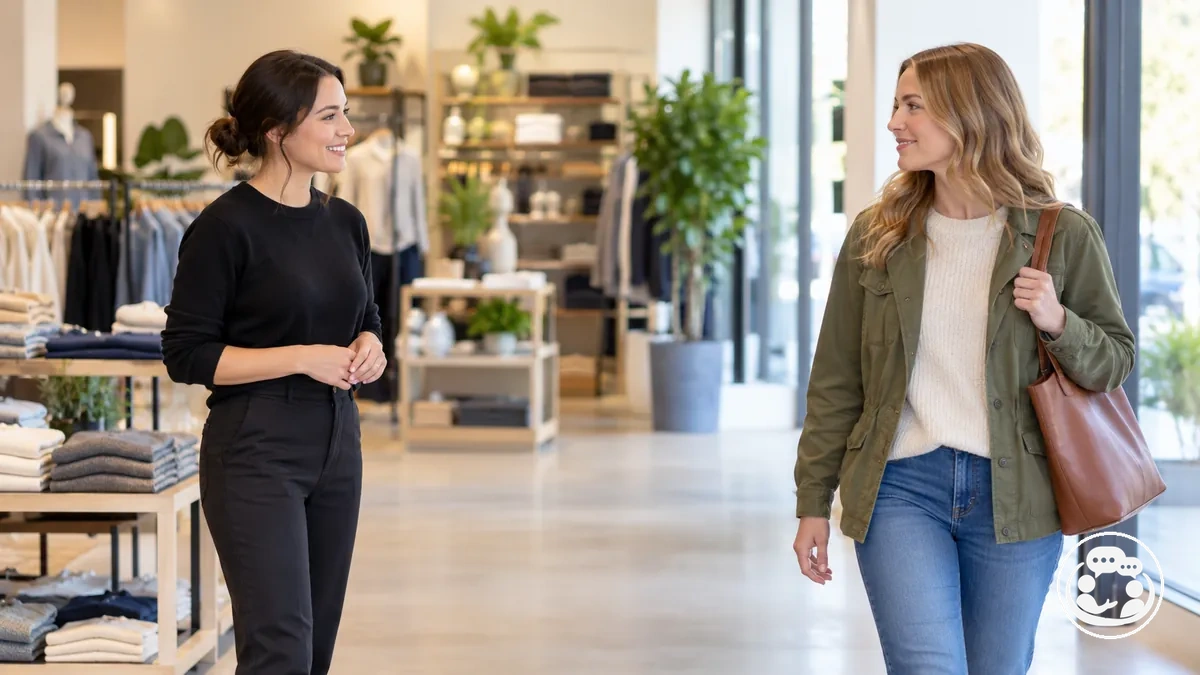
Natural wording can be as simple as “Hi, welcome in,” “Good morning,” or, where the store context and familiarity suit it, “Nice to see you again.” A concise acknowledgement such as “Hi, welcome in” creates less response burden than an over-elaborate greeting that combines an enthusiastic welcome, personal comments, and several questions at once.
The exact greeting can change with the time of day and customer familiarity, while a calm, warm tone can help brief wording feel natural rather than rehearsed.
Use Eye Contact and Open Body Language With the Greeting
Non-verbal greeting behaviour should support the spoken greeting rather than overpower it.
Eye contact, facial expression, posture, approach angle, and personal space can affect how comfortable and approachable the interaction may feel.
Appropriate intensity varies with culture, store environment, and individual preference, so these behaviours should remain natural rather than exaggerated.
These parallel behaviours can support the verbal greeting in different ways, but their likely effect depends on the context in which the customer receives them.
- Eye contact: Brief, natural eye contact can accompany the acknowledgement without becoming prolonged or demanding.
- Facial expression: A relaxed, friendly facial expression can add warmth to the greeting without relying on exaggerated enthusiasm.
- Posture: An open, relaxed posture can make the associate appear more approachable, while tense or imposing positioning may feel less comfortable.
- Approach angle: An approach angle that leaves the shopper's path open can make the greeting easier to receive than positioning that feels intrusive.
- Personal space: Allowing comfortable personal space can reduce pressure, although suitable proximity varies with culture, store environment, and individual preference.
For example, the same brief greeting may feel more approachable when delivered with natural eye contact, a relaxed facial expression, and comfortable personal space than when paired with prolonged staring, close proximity, or an imposing posture.
These behaviours provide context for the greeting rather than confirming how a customer feels or intends to respond.
Offer Help Without Requiring an Immediate Decision
Make the offer of help optional so assistance is available without requiring the customer to stop browsing or make an immediate decision.
The wording and tone can fit the store context while making clear that the shopper may respond briefly, decline, or continue browsing.
Low-pressure sequence
- Offer: Make assistance available in one clear sentence, keeping it specific when the situation supports that.
- Pause: Give the shopper a real opportunity to answer, decline, or continue browsing before adding another question.
- Adjust: If the shopper engages, respond to that opening; if they decline or keep browsing, remain available without pressing for another answer.
Phrase choice
Lower response burden
“Let me know if you’d like help finding anything.”
One offer makes help available while leaving the customer free to choose whether to engage.
Higher response burden
“What are you looking for, and what can I show you?”
Stacked questions ask for more engagement before the shopper has chosen to continue the conversation.
Retail Greeting Examples for Different Customer Responses
Retail greeting examples should be treated as adaptable patterns because the same greeting principle can call for a different adjustment depending on the customer's immediate response.
An engaged response may allow the interaction to continue, while a brief response or a preference for more space may call for greater conversational space.
Tone, timing, attention, and continued browsing provide context for the next move rather than defining a fixed customer type.
The shared pattern is customer response → greeting adjustment → rationale: observe the immediate response, make a low-pressure adjustment, and preserve appropriate conversational space.
These examples stay within the early greeting stage, where the adjustment concerns tone, timing, and space rather than product recommendations, objection handling, or closing.
When the Customer Engages Immediately
When a customer engages immediately by responding warmly, asking a question, or otherwise showing openness to conversation, acknowledge the response and answer or reciprocate naturally.
The next move should match the level of interaction the shopper has opened rather than automatically advancing the conversation.
Immediate engagement shows willingness to talk at that moment, not confirmed purchase intent.
When the Customer Gives a Brief Response
When a customer gives a polite but brief response to a greeting, the brevity is ambiguous and does not necessarily indicate either strong interest or rejection.
Tone, continued browsing, attention, and orientation toward or away from the associate provide additional context for interpreting the response.
Acknowledge the reply without overreading it, then allow the shopper to influence whether the conversation continues.
What to watch next
Attention returns to the associate
If the shopper remains oriented toward the associate or redirects attention back to them, stay available for the conversation to continue.
Attention stays on merchandise
If the shopper keeps browsing and their orientation moves away, pause and step back rather than immediately adding another question.
A respectful pause keeps assistance available without demanding more interaction than the customer has offered.
When the Customer Signals They Want Space
When a customer appears to want more space, reduced eye contact, attention returning to merchandise, brief decline language, or movement away from the associate may suggest a preference for browsing without further interaction at that moment.
These cues are context-dependent and do not prove the customer’s motive, so no single behaviour should be treated as definitive.
Acknowledge the situation, release pressure, and remain available rather than continuing the greeting more actively.
Retail Greeting Timing and Phrasing Mistakes to Avoid
A retail greeting mistake generally falls into one of two classes: timing or phrasing.
Poor timing can increase pressure when an approach is premature or leave acknowledgement too late, while poor phrasing can make the opening feel canned or unnecessarily close the conversation.
The likely consequence depends on the customer and context, so the mistake should be recognised through observable interaction rather than an assumed reaction.
The useful pattern is mistake → likely consequence → recognition cue → correction: identify what happened, observe how the interaction develops, then correct the relevant timing or wording choice.
Timing mistakes and phrasing mistakes therefore require different corrections even when both can make a greeting less comfortable or conversational.
- Timing mistakes: A premature approach or delayed acknowledgement can create pressure or weaken the opening; the recognition cue is whether the timing conflicts with the customer's immediate readiness for acknowledgement, and the correction is to adjust when the greeting occurs.
- Phrasing mistakes: Canned wording or a closed question can restrict the conversation; the recognition cue is whether the wording sounds inflexible or unnecessarily limits the customer's response, and the correction is to use natural, open phrasing suited to the greeting stage.
Timing Mistakes That Make the Approach Feel Intrusive
Intrusive greeting timing can arise from immediate interception at the entrance, approaching before the customer has had a chance for orientation, following too closely, interrupting concentrated browsing, or continuing to approach when the shopper appears to want more space.
These behaviours can create pressure because the timing of fuller engagement may conflict with what the customer is doing at that moment.
A simple acknowledgement and fuller engagement are distinct actions, so they can appropriately occur at different moments depending on store layout, staffing, traffic, and shopper behaviour.
The correction is to match the level of engagement to the immediate situation rather than replacing one rigid timing rule with another.
For example, an associate can acknowledge a shopper, remain visibly available, and wait for a more suitable opportunity for fuller engagement instead of repeatedly moving closer as the shopper browses.
That approach maintains attentive availability without hovering, while the specific timing still depends on the surrounding conditions.
- Immediate interception: Approaching as the customer enters can feel intrusive when it prevents them from settling into the store; acknowledge the arrival without requiring immediate fuller engagement.
- Approaching before orientation: Moving into fuller engagement while the shopper is still orienting to the environment may add pressure; allow orientation to develop before increasing the interaction.
- Following too closely: Repeatedly moving with the shopper at close proximity may crowd their browsing; remain available from a position that does not require constant following.
- Interrupting concentrated browsing: Starting or restarting fuller engagement while the customer's attention remains concentrated on merchandise can interrupt that activity; wait for a more suitable opening before re-engaging.
- Missing a preference for space: Continuing the approach when the shopper's behaviour reasonably suggests a wish for more space may make the interaction feel overbearing; step back while preserving visible availability for later assistance.
Canned or Closed Greeting Phrases That Shut Down Conversation
Canned or closed greeting phrasing can invite a short or automatic response when canned wording sounds rehearsed or a closed question narrows the customer’s available reply.
A yes/no question such as “Can I help you?” may make a brief yes/no response the easiest conversational path in some contexts, although the phrase itself is not inherently wrong and its effect also depends on tone and delivery.
The better wording principle is to leave room for a response without requiring the shopper to immediately explain a need.
Phrase pattern → likely issue → better principle
Mechanical delivery
Pattern: “Welcome in” delivered as a fixed recital.
Better principle: Keep the wording if it fits, but deliver it naturally and in context; the phrase itself is not the problem.
Stacked questions
Pattern: “Can I help you, what are you looking for, and is there something specific you need?”
Better principle: Make one clear offer, then allow the customer to respond before adding another question.
Assumed goal
Pattern: “What are you buying today?”
Better principle: Use neutral wording that makes assistance available without assigning a purchase intention the shopper has not expressed.