
A material concern is still open
Clarify first. Resolve the decision-relevant question before asking for the sale.
Ask for the sale naturally when the shopper has a clear preference and no unresolved material concern, and is willing to discuss the next step. Ask one clear question that matches the decision already under consideration; if hesitation reveals uncertainty or a remaining concern, clarify that issue or give space instead of repeating the close.

Choose the next closing move
Use the shopper’s current decision state—not a magic phrase—to choose the next action. No single cue proves purchase intent.
A material concern is still open
Clarify first. Resolve the decision-relevant question before asking for the sale.
A preference is emerging, but readiness is still uncertain
Use a soft close. Offer one relevant, reversible next step, such as checking availability or discussing delivery.
A clear preference is expressed, no material concern remains, and the shopper is willing to proceed
Ask directly. “Would you like to proceed with this item?” Then pause and let the shopper answer.
The shopper hesitates, needs time, or clearly declines
Respond to the reason, not with more pressure. Clarify only what remains unclear; otherwise give space or end the interaction politely.
Core rule: when the preference is clear, material concerns are resolved, and the shopper is willing to proceed, ask one clear closing question and then give neutral space for the answer.
A closing question should follow the needs and concerns already discussed. Readiness is judged from the conversation as a whole, and the shopper’s response determines whether to proceed, clarify, pause, or end the close.
A closing question is timely only when the shopper’s expressed preference and remaining concerns reasonably support moving forward.
No single cue proves purchase intent.
Readiness is better evaluated from the conversation as a whole, including whether the shopper is willing to discuss a next step.
The criteria below organize conditions for deciding whether to ask now or clarify first; they do not guarantee a purchase.
A stated preference can support a close when material questions have been resolved, while uncertainty about fit, price, delivery, or suitability warrants clarification.
Because one cue is not definitive, readiness should be interpreted from the shopper’s preference, unresolved concern, and willingness to proceed together.
The image illustrates how a shopper can prefer an item while still having a question that needs clarification before the closing question.

For example, a shopper who selects a preferred item, resolves relevant questions, and indicates willingness to proceed may be ready for a closing question.
Asking while the shopper is still uncertain whether the item fits their needs would be premature because a decision-relevant concern remains unresolved.
These criteria indicate readiness conditions, not certainty that the shopper will purchase.
A natural closing transition moves from the shopper’s confirmed choice to a clear next step without changing the tone of the conversation.
Check that no material concern remains before moving into the close, then make the closing question consistent with the decision already under discussion.
The sequence below organizes the handoff from discussion to decision rather than prescribing rigid wording.
It prevents an abrupt jump by keeping each action connected to what the shopper has already said, while the image visualizes the order from checking concerns to asking one clear closing question.
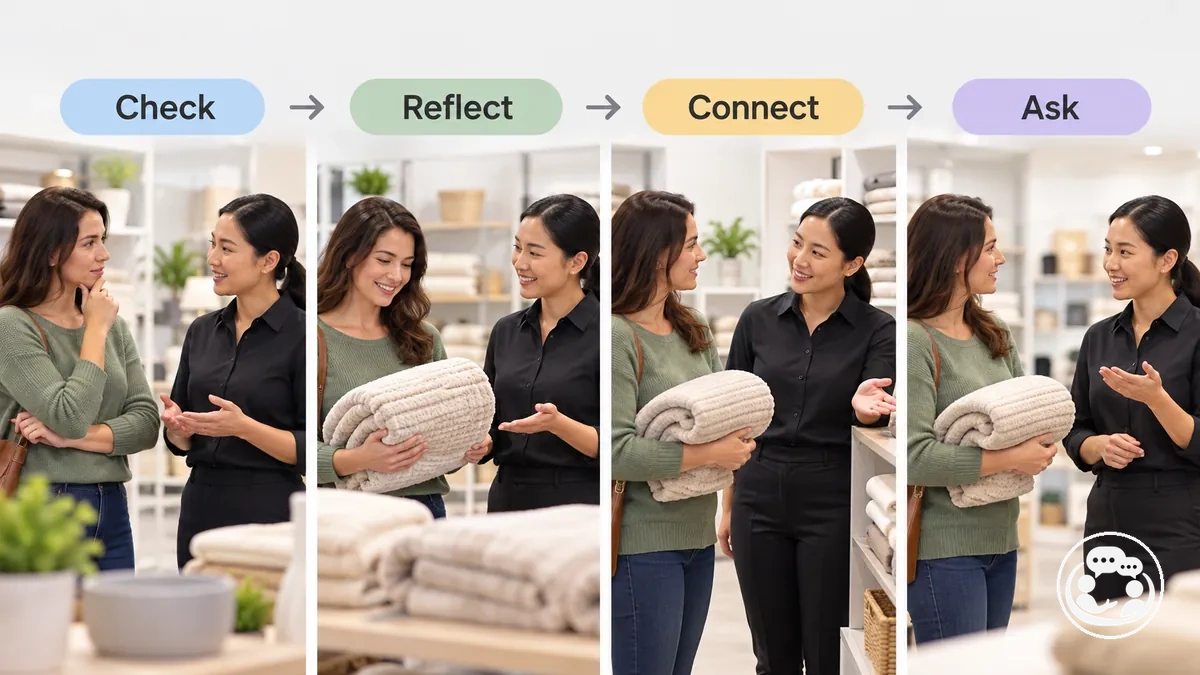
An abrupt transition might jump from discussing an option straight to asking for the sale, while a natural transition reflects the shopper’s chosen option and connects it to the next step first.
Before the final ask, verify that no new concern remains unresolved.
The closing question should match the decision the shopper is already considering.
Pause the close while an unresolved concern remains material to the shopper’s purchase decision.
Acknowledge the concern, clarify what still needs an answer, and use a resolution check before returning to the close.
The image demonstrates this pause-and-check moment without implying that clarification will always remove hesitation.
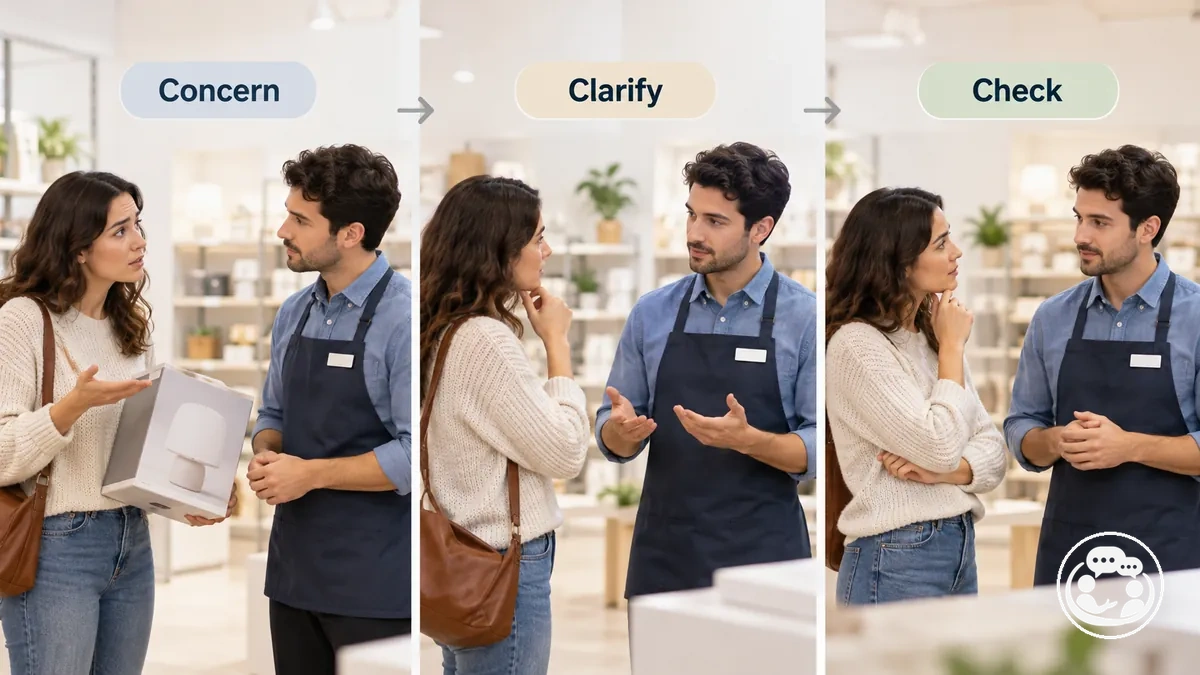
Connect the shopper's choice to one practical next purchase step that follows from what the shopper has actually decided.
Acknowledge the chosen option, then offer the relevant next action rather than treating interest as consent.
The image shows how a selected option can connect to a practical next action without presuming the purchase.
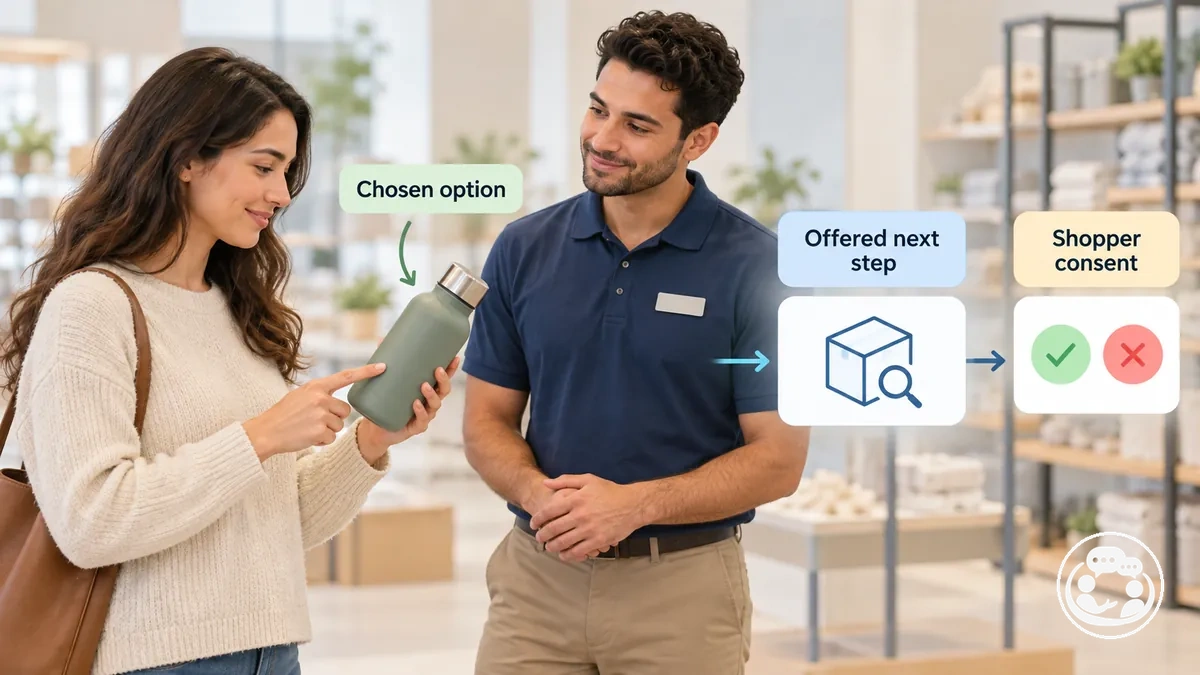
Match the next step to what remains to be confirmed
Keep the primary purchase decision separate from optional additions so related-item discussion does not interrupt the close.
An offered next step preserves consent, while a presumed next step treats the shopper's choice as permission to proceed.
A closing question should ask for one understandable decision or next action, then give the shopper room to answer.
Keep the question clear and specific to the decision already being considered.
The image demonstrates one decision per closing question followed by a neutral pause for the shopper’s response.
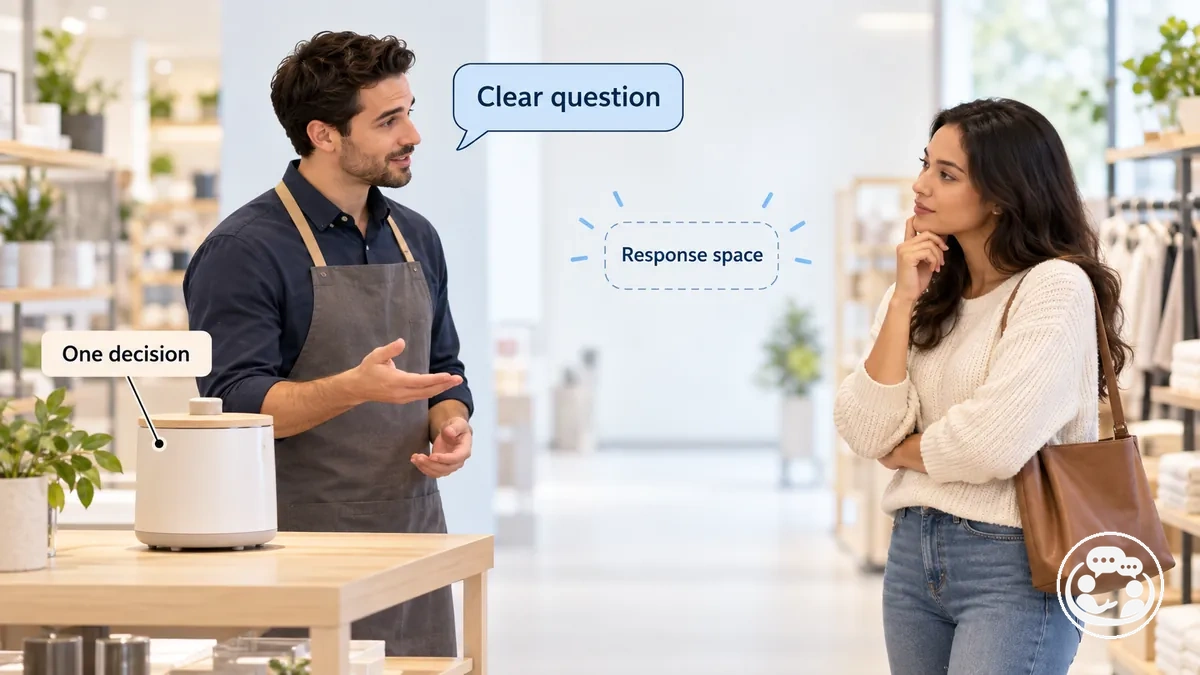
Each closing question should confirm a single relevant decision rather than combine several asks:
One clear question gives the shopper a specific choice and space to answer, while an overloaded question combines several decisions at once.
If the shopper gives a clear no, accept that answer rather than repeating the ask; clarity and response space keep the close respectful and reduce pressure.
Soft and direct closing questions serve the same decision context, but they request different levels of commitment.
A soft close checks a lower-commitment next step, while a direct close explicitly asks for a purchase decision.
Shopper readiness and the decision already under discussion influence which closing question fits the situation.
Neither approach is inherently weak or aggressive.
The comparison organizes commitment, timing, question function, and mistiming risk under the same criteria.
It compares suitable context rather than ranking either approach as a universal winner.
| Approach | Commitment requested | Shopper condition | Question function | Risk if mistimed |
|---|---|---|---|---|
| Soft close | Lower commitment to a next step or further decision check | Readiness is still developing or the shopper has not clearly reached a purchase decision | Checks willingness to continue toward the next step without requiring an immediate purchase decision | May leave the decision unclear when the shopper is already ready for an explicit purchase question |
| Direct close | Explicit commitment to a purchase decision | The shopper has expressed a clear preference, no material concern remains, and the conversation has reached the purchase decision | Asks clearly whether the shopper wants to proceed with the purchase | May create unnecessary pressure when the shopper is not ready to make that decision |
The trade-off is the level of commitment requested at that point in the conversation.
A soft close may suit a shopper who needs a lower-commitment check before deciding, while a direct close may suit a shopper already considering the purchase decision explicitly.
Direct wording does not make a closing question aggressive, just as softer wording does not make it weak.
Method choice should match the shopper's decision state and readiness.
A soft close fits uncertain readiness because it checks willingness through a low-commitment, reversible next step rather than requesting an immediate purchase decision.
It can test comfort with a preference, availability check, delivery discussion, or holding an item when that action matches the retail situation.
The shopper's response then indicates whether to proceed, clarify, or give space.
Soft-close pattern
“Would you like me to check availability for that option?”
“Would you like me to explain the delivery options?”
A soft close is a readiness check, not repeated persuasion.
A direct close fits when the shopper has expressed a clear preference, no material concern remains, and the conversation has reached the purchase decision.
It asks explicitly for the purchase decision or another commitment that is already under discussion.
Direct wording should remain clear and respectful; it should not treat enthusiasm, interest, or product preference as consent.
Match the closing question to the commitment being requested: “Would you like to buy this item?” asks for the purchase decision, while “Would you like to proceed to checkout?” asks for the next action.
“Would you like two of these?” confirms quantity when quantity is already relevant, and “Would you like to arrange the agreed fulfilment option?” addresses fulfilment.
A direct close asks plainly, but the shopper must remain free to decline without repeated pressure.
Shopper hesitation calls for clarification rather than a stronger closing push.
A pause after a closing question may reflect uncertainty, an unresolved concern, a need for time, or limited purchase intent.
Because the observed hesitation does not establish its cause, check what is preventing the shopper from deciding before choosing the next response.
Product uncertainty may indicate that the shopper is not yet confident about the selected option.
An unresolved concern means a decision-relevant question still needs an answer, while a need for time calls for a pause rather than repeated pressure.
Clear lack of intent differs from temporary uncertainty because the shopper indicates that they do not want to proceed.
The diagnostic table organizes each hesitation signal, a possible reason, a clarifying check, and the appropriate corrective direction.
Each interpretation remains conditional because similar hesitation can reflect different decision states.
| Observed hesitation | Possible reason | Clarifying check | Appropriate direction |
|---|---|---|---|
| The shopper remains unsure about the selected product. | Product uncertainty | Ask what they are still uncertain about regarding the option. | Clarify the relevant product information, then allow the shopper to reconsider. |
| The shopper raises a specific unanswered issue before deciding. | Unresolved concern | Check whether that concern is preventing the purchase decision. | Answer the relevant concern before returning to any closing question. |
| The shopper says they need more time before deciding. | Need for time | Confirm whether they want time to consider the decision without further discussion. | Pause the close and give the shopper space to decide. |
| The shopper clearly states that they do not want to proceed. | Clear lack of purchase intent | Accept the stated decision rather than searching for another hidden reason. | End the close without asking another version of the closing question. |
For example, uncertainty about whether an item suits the shopper's needs warrants clarification, while a request for time warrants a pause.
A clear decision not to proceed should end the close rather than trigger another closing attempt.
Hesitation therefore does not necessarily equal an objection; the appropriate response depends on what the clarifying check establishes.
A retail closing mistake can create pressure when it distorts timing, restricts choice, or makes the purchase decision less clear.
A mistimed ask may ignore readiness, while unclear wording can leave the shopper unsure what decision is being requested.
Repeated asking, urgency, or an unsupported assumption can further narrow the shopper's ability to respond freely.
The following closing mistakes are grouped by how they affect timing, choice, or clarity.
Each pattern includes its likely consequence, a recognition cue, and a practical correction.
A pressure-producing line such as “You should just get it now” uses urgency and assumption instead of a clear question.
A respectful correction is “Would you like to proceed with this item?” because it requests the decision while preserving the shopper's choice.
The correction should address the closing behaviour rather than assign blame.
A non-purchase should end by accepting the shopper decision and removing pressure from the sales interaction.
A clear decision not to buy should not trigger another attempt to reopen the sale.
Final assistance can remain appropriate when the shopper's stated situation leaves room for a neutral next step.
The conversational endpoint changes according to whether the shopper gives a definite no, needs time, or is still browsing.
Each situation calls for a respectful ending that matches the decision state.
Here, “closing” means ending a sales interaction without a purchase, not closing the store at the end of operating hours.
It does not refer to asking customers to leave the premises.