
Writing Flexible Retail Sales Scripts for Real Conversations
A flexible retail sales script is a conversation framework, not a memorised transcript. Define the conversation goal, map each stage to a purpose and completion cue, use prompts and listening cues instead of mandatory sentences, then let the customer’s actual response determine whether to continue, clarify, pause, branch or return to an earlier stage.

Flexible retail sales script blueprint
Build the script around five linked decisions. Each part defines what the associate needs to accomplish while keeping the wording responsive to the customer.
-
1
Plan the conversationSet the goal, note the customer context, identify missing information and constraints, then define the next useful action.
-
2
Map stages to purposesGive each stage one job, the input it needs and a completion cue that can support a handoff.
-
3
Draft functional cuesWrite the key point, question cue, listening cue, optional phrasing and transition cue instead of fixed dialogue.
-
4
Branch from observed responsesContinue, clarify, pause, return or give the customer space according to the information actually expressed.
-
5
Role-play and reviseTest realistic response paths, record friction, change the most likely wording, sequence or decision variable, then rerun the scenario.
Drafting rule: script the purpose, cues and decision conditions; keep exact phrasing adaptable.
Unlike a word-for-word transcript, the framework keeps the conversational purpose stable while wording, pace, sequence and next action can adapt to the customer, product context, store situation and information that emerges during the interaction.
Listening supplies the information for those choices: the associate uses what the customer actually says to decide whether the current stage is complete or whether the conversation needs clarification, a different branch or more space.
Table of Contents
Plan the Script Around the Conversation Goal and Customer Context
A retail sales script plan starts by defining the conversation goal before specific wording is drafted.
The conversation goal states the objective of the interaction, while the customer context identifies conditions that can change the next useful action.
A customer who is browsing, making a specific request, or providing limited information may therefore need different prompts or a different sequence.
The retail sales script plan should separate what is known from what still needs to be learned.
The conversation goal defines the intended outcome, known customer context establishes the starting point, an information need identifies what remains unclear, and each constraint limits which next action is appropriate.
The desired conversational outcome should then be expressed as a practical next action that can remain open to the customer response.
These planning conditions can also be represented visually to show how the conversation goal, customer context, information need, and constraint shape the prompts considered before wording is written.

- Conversation goal: define the objective the interaction should move toward.
- Customer context: record relevant information already known, such as whether the customer is browsing or has a specific request.
- Information need: identify what remains unknown and therefore needs an appropriate prompt.
- Constraint and next action: account for conditions that limit the sequence, then leave the next useful action responsive to what the customer says.
For example, a browsing customer may call for an open prompt that leaves the sequence flexible, while a specific product request may make clarification the immediate objective before moving further.
Once the conversation goal, customer context, information gaps, constraints, and likely next action are clear, the plan is ready to be mapped into flexible conversation stages rather than written as a memorized speech.
Build a Flexible Structure Around Conversation Stages and Decision Points
A conversation framework organizes the retail interaction into conversation stages connected by response-led decision points.
Each conversation stage has a purpose, while each decision point uses customer input or a signal to guide the next action.
This creates a directional sequence without requiring every conversation to follow the same path.
The main sequence shows how one stage hands the conversation to the next while leaving room for the customer response to change that handoff.
A signal may support continuing to the next stage, while missing information, uncertainty, or a changed request may cause the conversation to pause, repeat, skip ahead, or return to an earlier stage.
The ordered sequence therefore represents the normal direction of the conversation framework rather than a mandatory route.
- Establish the current stage: identify the purpose the conversation needs to serve at that point.
- Consider customer input: listen for the response or signal that indicates the customer's current state.
- Use the decision point: decide whether the signal supports continuing, pausing, repeating, skipping, or returning to an earlier stage.
- Make the handoff: move to the next action or branch that fits the customer response.
The relationship between stages and response-led decision points can also be shown visually so that a normal handoff remains distinct from a branch created by a different customer signal.
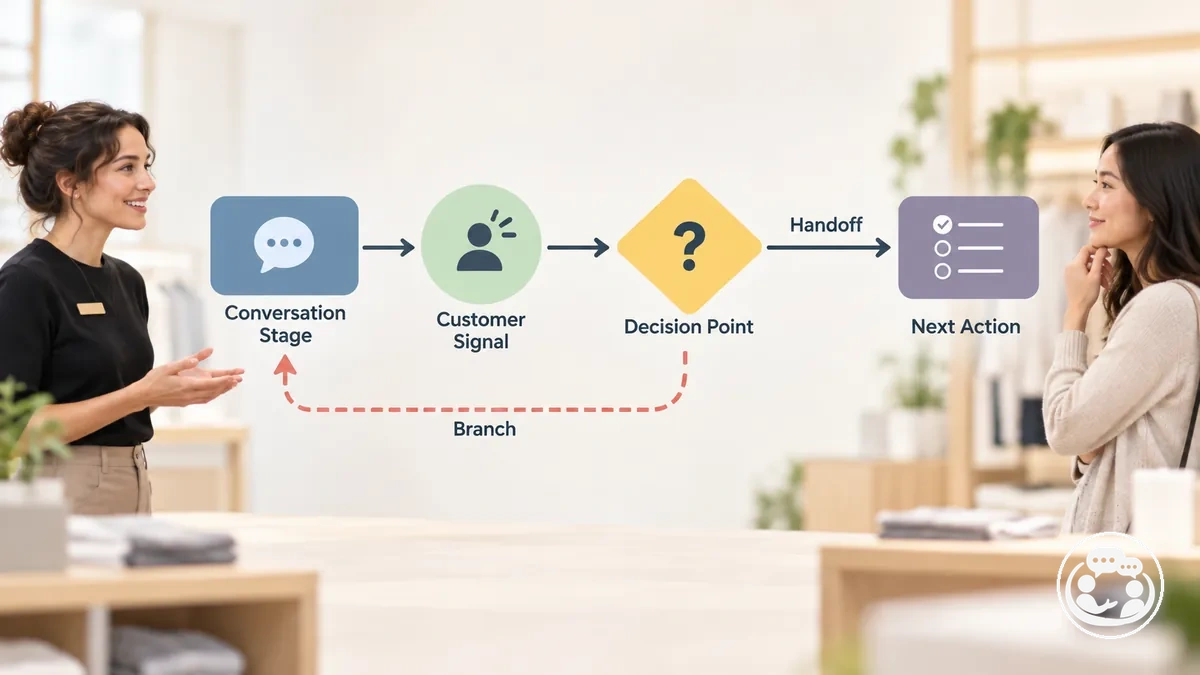
For example, a normal path may move from one completed conversation stage to the next when the customer response provides the needed input, while uncertainty or missing information may create a branch back to an earlier stage before the conversation continues.
The framework defines these stage, decision point, and handoff relationships without prescribing the specialised dialogue used inside each stage.
Map Each Stage to Its Purpose
Each conversation stage needs one primary stage purpose and a clear completion cue before exact wording is drafted.
The stage purpose defines the job the stage serves, while the completion cue identifies the condition that can allow a handoff to the next stage.
Mapping the required input alongside the completion cue keeps the structure focused on what customer information must be obtained or what information must be communicated.
This helps prevent a conversation stage from accumulating duplicated or aimless dialogue because its objective, required input, and handoff condition remain explicit.
| Stage | Purpose | Required input | Completion cue |
|---|---|---|---|
| Opening stage | Establish the immediate context for the interaction. | The customer's initial request, response, or reason for engaging. | The interaction has enough context to continue appropriately. |
| Information stage | Clarify the customer information needed for the conversation. | Relevant needs, preferences, questions, or missing details. | The information needed for the next appropriate handoff is sufficiently clear. |
| Option stage | Communicate information that responds to the clarified context. | The customer information established in the preceding stage. | The customer response indicates whether to continue, clarify, or return for more information. |
A stage-purpose relationship can also be visualized through the handoff between the stage objective and the customer response, complementing the table without repeating its full mapping.

For example, an information stage should not continue collecting details once the customer information needed for the next appropriate action is sufficiently clear; that condition can signal a handoff, while an unclear response may require the stage to continue.
The completion cue therefore guides the transition without making one condition a universal rule for every customer conversation.
Connect Stages With Response-Led Decision Points
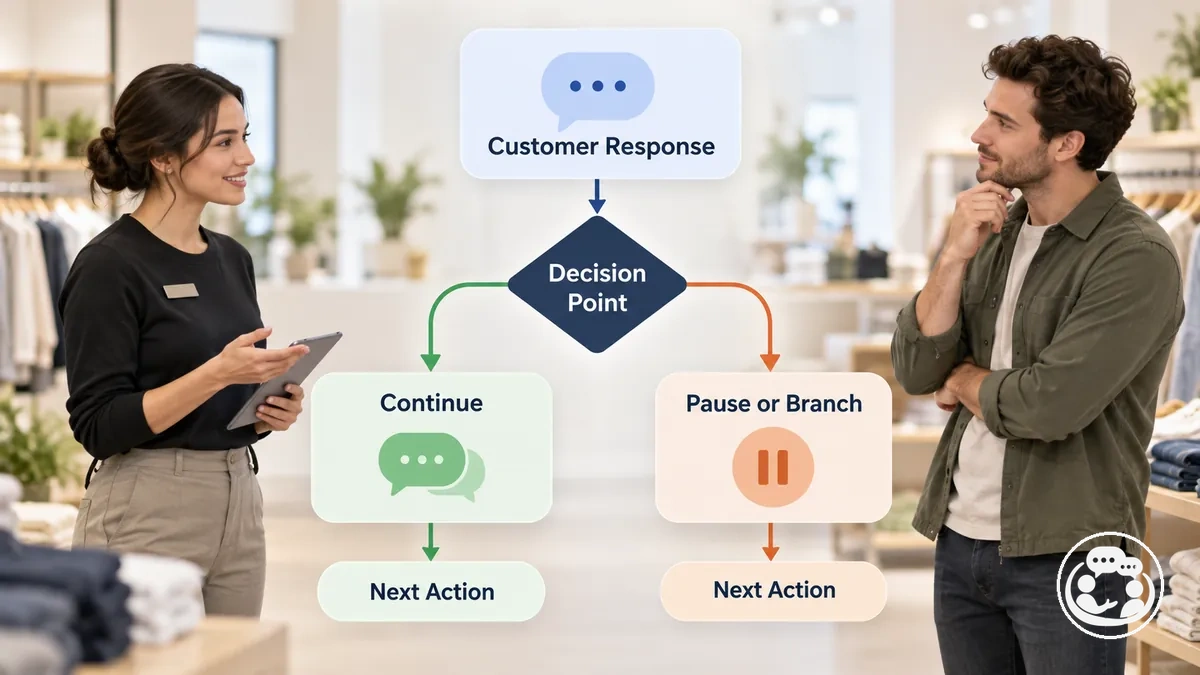
A response-led decision point uses the customer response to determine whether the script should continue, pause, branch, or return to an earlier stage.
The next action should follow the observable response condition rather than a predetermined reply for every possible sentence.
At each decision point, the response condition provides the information to interpret before choosing the next action.
Clear interest can support continuing when the response also provides enough information to proceed, while uncertainty can indicate a need to pause and clarify.
Missing information can require a return to an earlier stage, while a request to browse can create a branch that gives the customer space rather than forcing the sequence forward.
These interpretations remain conditional because a single customer response can suggest a direction without proving intent.
- If clear interest is expressed: then continue when the customer response provides enough context for the next action.
- If uncertainty is expressed: then pause and check what needs clarification before continuing.
- If required information is missing: then return to the relevant earlier stage to obtain it before choosing the next action.
- If the customer asks to browse: then branch away from the immediate sequence and leave the conversation open for a later handoff.
For example, at the same stage, a customer who asks a specific follow-up question may provide enough context to continue, while a customer who says they want to look around may lead to a branch that pauses the current sequence.
The image illustrates this branching relationship without prescribing every reply or treating either response as definitive proof of intent.
Draft Natural Talk Tracks Instead of Word-for-Word Dialogue
A natural sales talk track is drafted from each stage purpose and its cues rather than as a word-for-word transcript.
The stage purpose defines what the associate needs to accomplish, while each cue guides what to ask, listen for, communicate, or do next.
Exact wording can then adapt to the customer's language, tone, and information instead of forcing the same sentence into every conversation.
Build the sales talk track in sequence by converting the stage purpose into practical guidance.
Each step should clarify the conversational job while leaving enough flexibility for the associate to respond to the customer.
- Define the stage purpose: state the outcome the current part of the conversation needs to accomplish.
- Write the key talking point: identify the information that needs to be communicated without scripting a complete speech.
- Add a question cue: specify what the associate needs to ask when more customer information is required.
- Add a listening cue: identify the customer language or information that can affect how the conversation proceeds.
- Draft optional phrasing: provide flexible wording that expresses the talking point without requiring one mandatory sentence.
- Add a transition cue: indicate how the associate can move toward the next action when the customer response supports that transition.
Rigid wording
“Tell me exactly what product you need today.”
One required line can force the same phrasing even when the customer context calls for a different opening.
Flexible wording
“What are you looking for today?” or “Is there something specific you’d like help with?”
The wording can change while the information-gathering purpose remains the same.
The image illustrates how a stage purpose can become cues and optional phrasing without turning the sales talk track into fixed dialogue; the method defines drafting structure rather than diagnosing every reason a conversation may sound robotic or pushy.

Write Key Points, Prompts, and Optional Phrasing
Translate each stage purpose into a small set of functional script cues: a key point, a prompt or question cue, a listening cue, optional phrasing, and a transition cue.
Each script cue should have a defined job, while the exact wording can change with the customer information, response, and conversational context.
The cue set should separate what needs to be communicated from what needs to be learned, heard, or used to guide the next move.
A key point carries the essential message, while a prompt or question cue seeks specific customer information and a listening cue identifies the response that matters for the current purpose.
Optional phrasing provides alternative ways to express the same intent, and the transition cue indicates when the conversation can move forward.
These functions keep the script usable without requiring one wording choice in every interaction.
- Key point: identify the essential message or purpose the associate needs to communicate.
- Prompt or question cue: specify the customer information the associate needs to elicit, such as the purpose, preference, or detail needed for the current stage.
- Listening cue: identify the part of the customer's response that may affect what information or action is appropriate next.
- Optional phrasing: provide two or more wording options that express the same intent while allowing adaptation to the customer's language and context.
- Transition cue: state the response or information condition that can support moving to the next conversational action.
For example, a prompt intended to learn what the customer is looking for could use optional phrasing such as “What are you looking for today?”, “Is there something specific you'd like help finding?”, or “What can I help you with?” The wording changes, but the script cue retains the same information-gathering purpose rather than becoming fixed wording for every customer.
Leave Room for Listening and Customer-Specific Adaptation
Customer-specific adaptation requires the script to leave deliberate room for listening before the associate changes the wording, pace, question depth, or next action.
The customer response provides the observed information for that adjustment, while any interpretation of preference or uncertainty should remain tied to what the customer actually says rather than assumed intent.
- More relevant detail
- Use more specific wording, and increase question depth only where further clarification is useful.
- Less detail
- Slow the pace and use a broader follow-up prompt so information can emerge without forcing extra questions.
- Expressed uncertainty
- Pause or clarify the current point before choosing the next action.
- Stated preference changes the context
- Shift the wording or next action toward that stated preference rather than the previously assumed path.
For example, an associate may plan to ask which product features matter most, but the customer may first say they need an item that fits a specific space at home.
Instead of delivering the planned line, the associate can respond to that customer information by asking about the available space, then adapt the later question depth and next action once the relevant constraint is clearer.
Role-Play the Script and Revise It Before Use
A role-play test checks whether the draft is usable under varied customer responses rather than whether an associate can memorise its wording.
Each practice run should expose how clearly the script guides the conversation, how much adaptability it allows, and whether its listening space and transition quality support a sensible next action.
One scenario can reveal friction or a missed cue, but it should not be treated as proof that the script is ready or unusable in every situation.
Use the role-play as an ordered practice loop, recording observable points of friction before making a revision.
Each step combines one practice action with a check on how the script performs during the scenario.
- Choose a realistic scenario: define a plausible customer response or situation that gives the script something specific to handle.
- Run the conversation: complete the practice run without stopping to edit, checking whether the sequence leaves enough room for listening and adaptation.
- Note friction and missed cues: record where wording feels difficult to use, a relevant customer response is missed, or transition quality makes the next action unclear.
- Debrief against the goal: compare the observations with the script's intended purpose and check whether its decision points lead to sensible next actions.
- Revise the draft: adjust the part of the script linked to the observed problem rather than rewriting unaffected material.
- Repeat the role-play: use another plausible response condition to check whether the revision improves usability without making the script rigid.
During the debrief, distinguish script friction from simple unfamiliarity with the practice process.
Repeated awkward transitions, missed cues, unclear sequencing, or difficulty adapting across practice runs can justify revision, while hesitation in a single rehearsal may reflect limited familiarity rather than a defect in the script.
Record the scenario, the observable customer response, where the friction occurred, and the resulting revision so later practice can check whether clarity, adaptability, listening space, and transition quality improve.
Test Alternative Customer Response Paths
A response-path test is useful when materially different customer responses expose a branch that fails or becomes unclear because the next conversational action changes.
Test the same script against different response conditions so the expected decision point can be compared with the actual outcome without treating one practice run as evidence of a universal problem.
The expected decision point is the branch the script is intended to take for the observed customer response, while the actual outcome records what happened during the practice run.
Comparing those two states makes the revision cue explicit without assuming that hesitation, an incomplete answer, or another response confirms the customer's intent.
| Customer response | Expected decision point | Actual outcome | Revision cue |
|---|---|---|---|
| Incomplete answer | Keep the branch open and seek the information needed for the next action. | The script moves forward before enough information is available. | Revise the branch so missing information can trigger clarification. |
| Unexpected priority | Shift the branch toward the newly stated priority. | The script continues with the previously assumed priority. | Revise the decision point so a changed priority can redirect the next action. |
| Hesitation | Leave room to clarify the response before selecting the next action. | The branch treats hesitation as sufficient reason to continue or stop. | Revise the branch to require relevant customer information rather than inferred intent. |
| Strong interest | Continue when the response provides enough information for the intended next action. | The script either stalls or advances without checking whether the needed information is present. | Revise the decision point so progression depends on the relevant response condition. |
| Desire to browse | Allow the conversation to pause or branch away from the immediate sequence. | The script keeps directing the customer through the planned path. | Revise the branch so a stated desire to browse can change the next action. |
An unexpected outcome in one practice run can identify something worth observing again, but it does not establish that the branch is defective in every situation.
Repeated confusion or the same branch failure across more than one realistic practice run provides a stronger revision cue, especially when the expected decision point repeatedly fails to produce a sensible next action.
Revise Wording, Sequence, and Decision Points After Practice
Script revision should respond to observed friction from practice rather than stylistic preference alone.
Isolate the most likely wording, sequence, or decision point variable behind the problem, then make a targeted change that can be evaluated in a rerun.
Start with the observed friction and identify the likely variable: wording may be difficult to use because of sentence length or weak prompt clarity, while a sequence problem may appear when a stage occurs too early or too late, and a decision point may lack an option or a clear condition for the next action.
Make a targeted change to the most likely variable instead of changing several elements at once when doing so would make the result difficult to interpret.
Rerun the relevant scenario and compare what happens with the original observation.
The interpretation should then determine whether to retain the revision, adjust it again, or investigate another variable, because the same change may work differently across associates or customer situations.
- Identify observed friction: record the specific wording, transition, sequence, or branch behaviour that made the conversation difficult to continue.
- Locate the likely variable: determine whether the issue is most closely related to sentence length, prompt clarity, stage order, transition wording, a missing option, or a decision condition.
- Make a targeted change: adjust the selected variable while keeping unrelated parts of the script stable.
- Rerun the scenario: test the revised part under a relevant customer response and observe how the conversation proceeds.
- Interpret the result: compare the rerun with the original friction and decide whether the evidence supports keeping, adjusting, or reconsidering the revision.
For example, if an awkward transition repeatedly interrupts the flow between two stages, shorten the transition or move it to the point where the required customer information is available, then rerun the scenario.
Check whether the revised transition is easier to use and leads more clearly to the intended next action; if the friction remains, that result can indicate that the sequence or decision point, rather than the wording alone, needs further examination.
Common Retail Sales Script Writing Mistakes to Correct Before Use
The most important retail sales script writing mistakes are drafting choices that make the script unclear, rigid, difficult to adapt, or disconnected from the conversation's purpose.
An unclear purpose can leave a stage without a defined conversational job, while over-scripting can make wording too rigid to adapt to a customer response.
Generic phrasing, a missing response branch, an abrupt transition, or excessive content can likewise create observable writing problems that should be corrected before use.
These are script flaws to diagnose through what appears in the draft and during practice, not assumptions about the associate or customer.
Each mistake can be checked through the same relation: identify the drafting condition, observe its practical consequence, use a recognition cue to locate the problem, and choose a corrective direction that addresses that specific flaw.
The table keeps those relationships explicit without assuming that correcting one writing error will resolve every conversational outcome.
| Mistake | Practical consequence | Recognition cue | Corrective direction |
|---|---|---|---|
| Unclear purpose | The associate may have no clear basis for deciding what the current part of the conversation should accomplish. | The stage contains wording or prompts but no identifiable conversational objective. | Define the stage purpose and keep its wording tied to that purpose. |
| Over-scripting | Rigid wording can make adaptation difficult when the customer response differs from the anticipated path. | The draft requires specific sentences even when the customer's information changes what should happen next. | Replace mandatory dialogue with key points, prompts, listening cues, and optional phrasing where flexibility is needed. |
| Generic phrasing | The wording may provide too little direction for the associate to obtain or communicate the information needed at that point. | A prompt could be used in many situations but does not clearly support the current purpose or information need. | Make the wording specific enough to serve the intended conversational job while leaving room for natural expression. |
| Missing response branch | The script may not provide a sensible next action when a materially different customer response occurs. | Practice reaches a response condition for which the draft offers no relevant continuation, pause, return, or alternative path. | Add a branch or decision condition for the observed response where it changes the appropriate next action. |
| Abrupt transition | The conversation may move between stages before the required information or context is established. | A transition feels premature, unclear, or difficult to use during practice. | Shorten, move, or clarify the transition so it follows the information or response condition needed for the handoff. |
| Excessive content | Too much scripted material can obscure the key point, prompt, or next action. | A stage contains wording that does not contribute to its purpose or repeats information already covered. | Remove or condense material that does not support the stage purpose, required information, or transition. |
| Lack of practice-based revision | Observable friction can remain in the draft because it has not been used to guide a targeted change. | The same wording, sequence, transition, or decision-point problem appears in practice without a corresponding revision. | Use the observed friction as the basis for a targeted change, then rerun the relevant scenario before interpreting the result. |
A correctable writing flaw is visible in the script or its use, such as rigid wording, a missing branch, or an unclear transition, and it has a corresponding drafting change that can be tested.
If the script provides clear purpose, adaptable wording, usable branches, and sensible transitions but conversations still produce inconsistent results, the issue may require broader diagnosis rather than another wording change.
One difficult interaction alone does not establish which type of problem is present.
Before use, verify that the script guides a consistent conversational intent while remaining adaptable to the customer’s actual responses.