
How to Respond When a Retail Customer Says “Just Looking”
When a retail customer says “just looking,” acknowledge the request, make help available once, and stop selling: “Of course—take your time. I’ll be just over here if you need any help.” Then give the shopper space; re-approach only after a meaningful change in behaviour or customer-initiated cue, not simply because a set amount of time has passed.
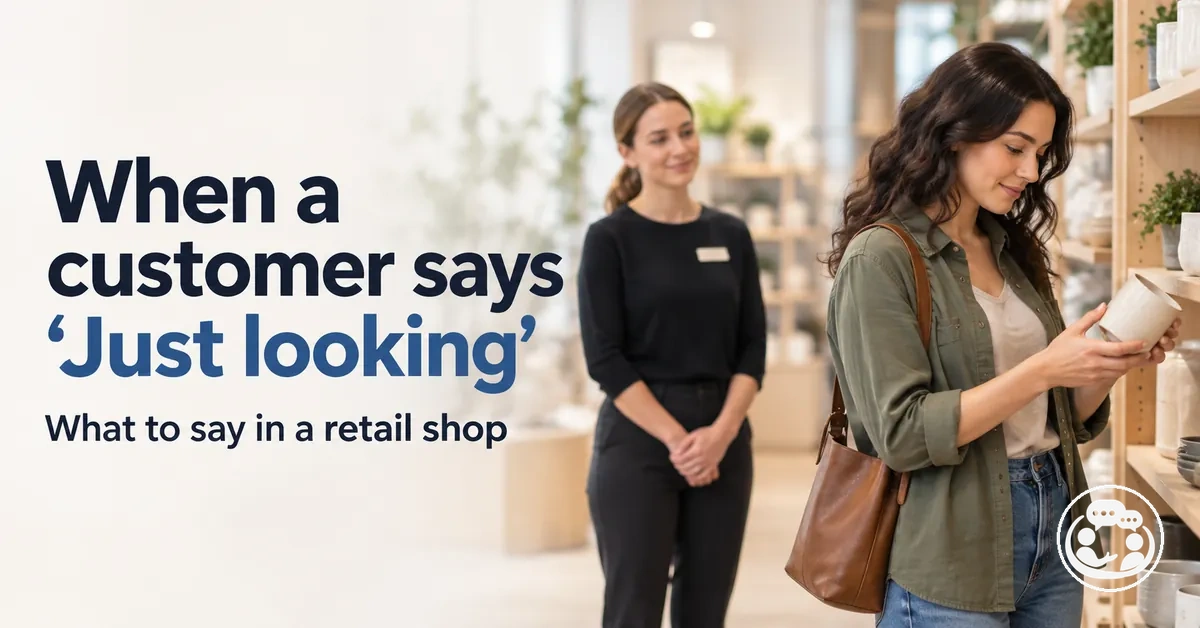
Low-pressure response path
Treat “just looking” as a request for space unless later behaviour gives a clearer cue. The phrase alone does not prove that the shopper is uninterested, ready to buy, or asking for help.
-
AcknowledgeAccept the request without challenging it.
Of course—take your time.
-
Stay available onceGive one clear availability cue without attaching another sales question.
I’ll be just over here if you need any help.
-
DisengageStop speaking, step back, and let the customer browse while remaining visible and accessible.
- If no stronger cue appears
- Keep giving space. Do not restart the conversation simply because time has passed.
- If the shopper re-engages or help-seeking cues align
- Offer one low-pressure check-in, then let the customer’s reply determine whether the conversation continues.
Key boundary: “Just looking” is not automatically an objection to overcome or a signal that the shopper is ready to buy.
The practical rule is to respond to the shopper’s stated preference for space first and use later observable behaviour only to decide whether renewed contact is appropriate.
Table of Contents
What to Say Immediately After a Customer Says “Just Looking”
Immediately after “just looking,” acknowledge the shopper, signal that assistance is available, and then give them space to continue browsing. The stopping point matters: once help is available, stop pressing the interaction.

Three-part response sequence
- Acknowledge the shopper. Respond briefly and use a calm, natural tone so the customer’s wish to continue browsing is accepted rather than challenged.
- Make assistance available. Signal that help remains available without attaching a follow-up question. For example, “No problem—have a look around, and I’m available if you need any help.” Exact wording can vary with the store context and customer preference.
- Disengage cleanly. Stop talking and let the shopper browse. Continuing with questions after the availability cue adds conversational pressure and removes the clear stopping point.
Acknowledge the Customer Without Challenging Their Request for Space
Acknowledge the customer by accepting their request for space rather than challenging or reframing it. The associate does not need to infer why the customer wants space; the immediate task is to recognise the preference and reduce conversational pressure.
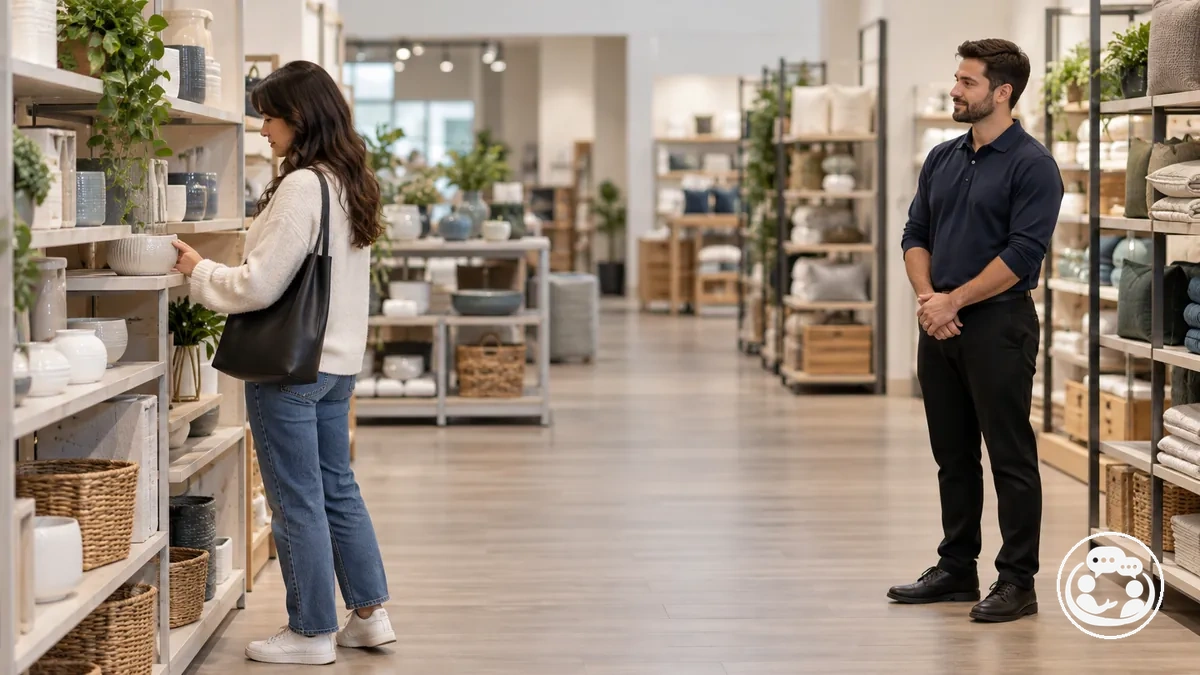
Key distinction
Respectful acknowledgement
Of course, take your time.
Accepts the request for space without adding conversational demand.
Pressuring reply
Are you sure I can’t help you find something?
Challenges the stated preference by requiring the customer to respond again.
Make Help Available Without Asking Another Sales Question
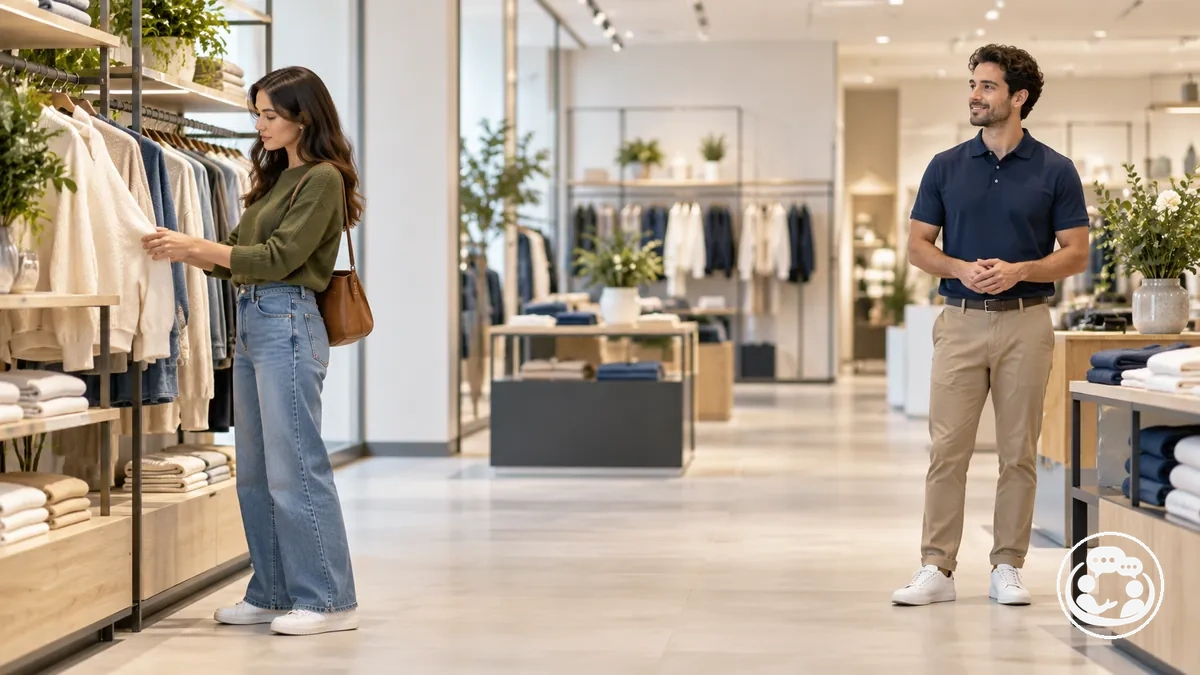
Make assistance available once without immediately asking another sales-oriented follow-up question. The wording can vary with the store setting, but the handoff should be brief and should not require a response.
Availability without pressure
- Availability cue
I’ll be just over here if you need any help.
- Stopping point
- After the cue, stop speaking rather than extending the exchange with another sales question.
- Who controls re-engagement
- The shopper decides whether to resume the interaction; the associate remains accessible without continuing to press.
What “Just Looking” Can Mean in a Retail Conversation
“Just looking” can correspond to more than one customer state, so the phrase alone is not proof of motive.
The shopper may genuinely want independent browsing, may use the phrase routinely when anticipating sales pressure, or may not yet be ready to explain what they need.
These are possible interpretations rather than fixed conclusions.
The diagnostic goal is to separate the words used from the customer state that later cues may suggest.
Observable behaviour, response to space, product attention, and willingness to re-engage provide more context for the interpretation.
The table organises recurring signals into possible interpretations, differentiating cues, and response implications rather than treating any single cue as confirmation.
| Observed signal | Possible interpretation | What to check next | Response implication |
|---|---|---|---|
| The shopper continues browsing independently after being given space. | Likely wants uninterrupted browsing at that point. | Notice whether product attention remains self-directed and whether the shopper chooses to re-engage. | Allow browsing to continue without extending the conversation. |
| The shopper says “just looking” but later looks toward or re-engages with the associate. | May still be open to help. | Check whether the shopper initiates contact or otherwise signals willingness to re-engage. | Remain available and respond if the shopper resumes the interaction. |
| The shopper gives a brief response and then focuses attention on products. | The phrase may be a request to browse before discussing a need. | Observe the response to space and whether later cues invite further interaction. | Treat the interpretation as provisional and avoid assuming a specific motive. |
The diagram maps the same “just looking” signal to different possible paths using observable behaviour as the qualifier rather than assigning fixed motives.
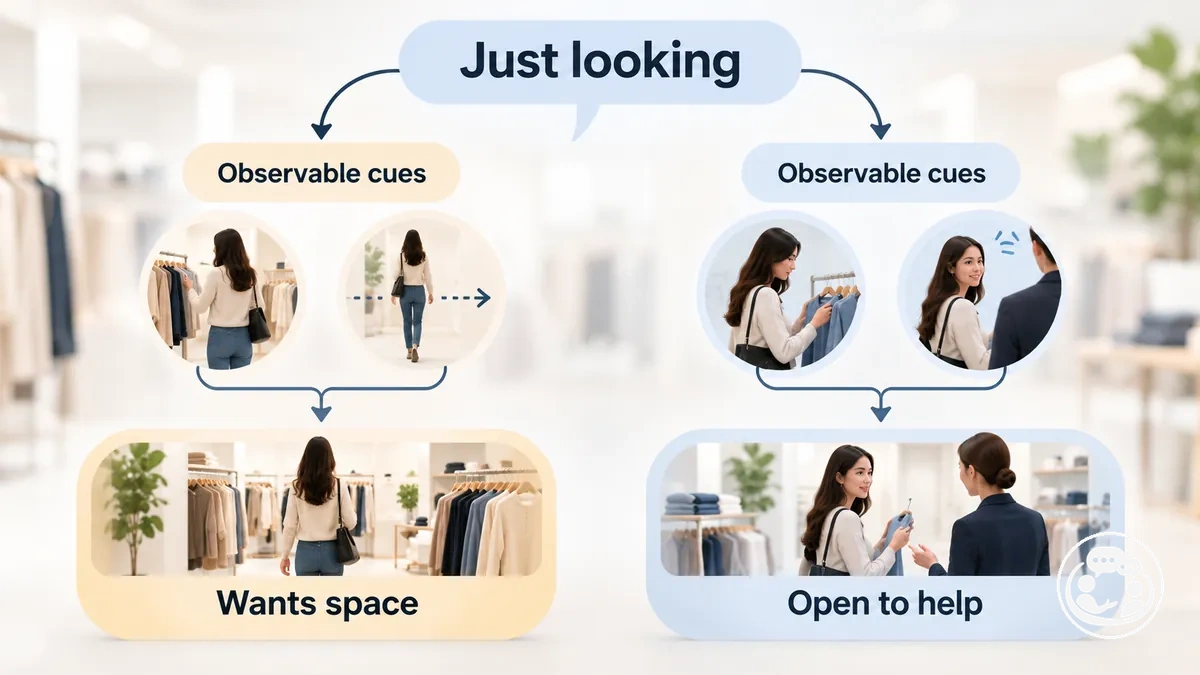
Any interpretation should remain provisional because the same phrase can accompany different patterns of browsing and re-engagement.
Further cues can refine the reading without confirming an underlying motive from one signal alone, beginning with the specific situation of a shopper who genuinely wants to browse alone.
When the Customer Genuinely Wants to Browse Alone
Several aligned cues can reasonably suggest that a customer wants uninterrupted browsing at that moment. An explicit request for space carries the most weight because the customer has stated the preference directly; brief answers, attention returning to merchandise, or movement away are weaker contextual cues and should not be treated as proof of motive on their own.
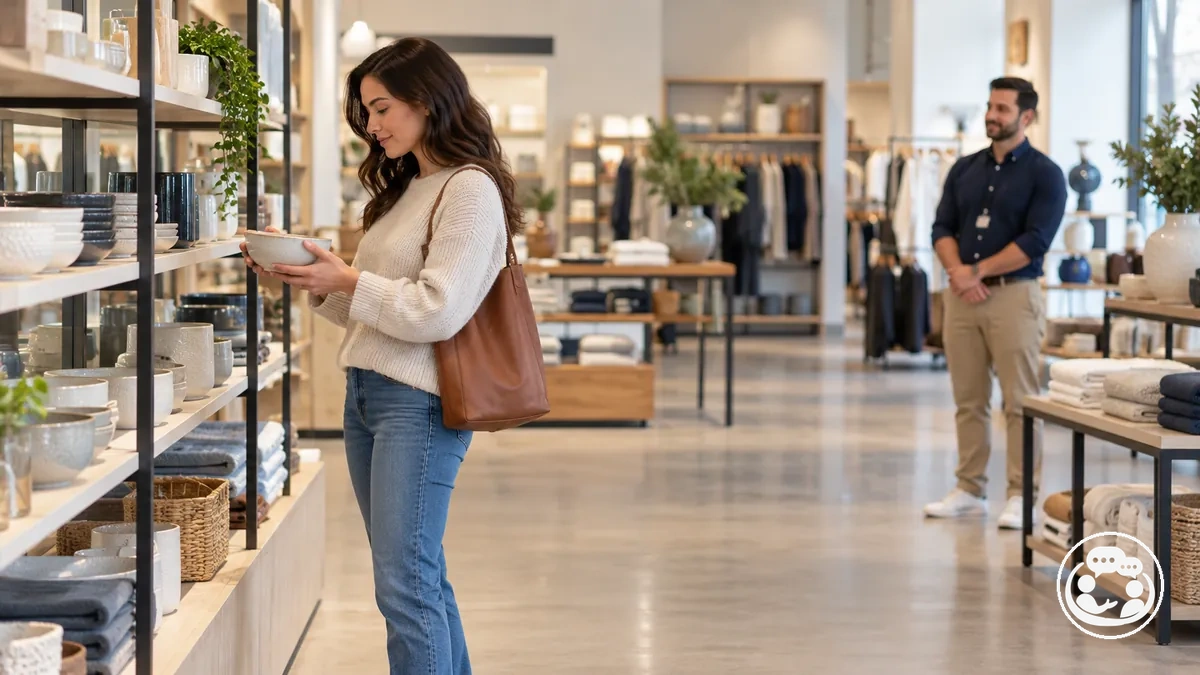
Cues that support giving more space
- Explicit request for space: If the customer directly asks to browse alone or requests space, reduce interaction while remaining available.
- Brief answers: Short replies combined with a return to browsing can support the interpretation that the customer does not want the conversation extended, so reduce interaction rather than continue questioning.
- Product attention: When the customer consistently redirects product attention toward merchandise rather than the conversation, continued questioning may add pressure; give them room while remaining available.
- Movement away: If the customer begins to move away from the interaction and continues browsing, reduce interaction and allow uninterrupted browsing while remaining available.
When the Customer Is Browsing but Still Open to Help
A browsing customer may become open to help when behaviour shifts toward information seeking or voluntary engagement. These are cues rather than guarantees of willingness to interact.
What changes the interpretation
- Product comparison or information search
- May show interest in the merchandise, but does not by itself establish that the customer wants assistance.
- Attention directed toward staff
- Looking toward the associate while information seeking is underway can strengthen the case for a low-pressure offer, especially when another cue aligns with it.
- Voluntary re-engagement
- Extending the conversation or asking about an item is a stronger signal that assistance may now be welcome.
How to Give a Browsing Customer Space Without Becoming Unavailable
Give the browsing customer physical and conversational space while remaining easy to find if assistance is needed. The aim is to step back without disappearing or repeatedly interrupting the shopper.
What determines the right amount of space
- Distance
- Create enough distance for independent browsing. No universal measurement fits every store; aisles, sightlines and the local layout change what is practical.
- Visibility
- Remain easy to find or approach. On an open retail floor, moving to another nearby task can preserve availability without hovering.
- Timing
- Do not use a fixed interval as the trigger to restart the conversation. Stay disengaged unless a clearer shopper-initiated or help-seeking cue emerges.
Space without disappearing
- Acknowledge the request. Accept that the customer wants space and avoid extending the exchange unnecessarily.
- Step back. Create enough distance for independent browsing, adjusting the position to the store layout rather than using a fixed measurement.
- Remain visible and accessible. Stay available in a practical location where the customer can find or approach you without being shadowed.
- Observe for a clear cue. Continue with another appropriate task while remaining attentive to a shopper-initiated cue that indicates assistance may be wanted.
- Avoid repeated interruptions. If no clearer cue emerges, stay disengaged rather than repeatedly checking in, while remaining accessible without hovering.
When to Approach a Browsing Customer Again
Re-approach a browsing customer when a meaningful change in behaviour or attention supports renewed contact, not simply because time has passed. The customer’s prior request for space remains the starting condition.
Criteria for waiting or re-approaching
- Customer-initiated engagement: A clear attempt by the customer to resume interaction supports re-approach more strongly than associate-initiated contact.
- Meaningful behaviour or attention change: A new observable shift may justify re-approach when it is consistent with seeking assistance rather than simply continuing to browse.
- Prior request for space: If that preference still appears unchanged and no stronger cue has emerged, the proportionate action is to wait.
- Situational context: Elapsed time and associate availability can inform the decision, but they should not replace evidence of changed customer behaviour.
Several aligned cues are more informative than one isolated gesture because cue strength depends on the surrounding context.
Wait for a Change in the Shopper’s Behaviour or Attention
Wait for a meaningful change in the shopper’s attention, movement, product interaction or active help-seeking rather than treating ordinary browsing as a trigger to re-approach. No single ambiguous cue automatically calls for re-engagement.
Cue strength increases when several observable changes point in the same direction or when the shopper actively seeks staff attention.
From weak cue to stronger cue
- Brief eye contact: A single glance toward staff is a weak cue when the shopper immediately returns attention to browsing, so waiting remains reasonable.
- Changed movement or product interaction: Pausing, changing direction, or handling a product differently may suggest a developing need, but the cue becomes stronger when another observable change occurs with it.
- Active information search: Looking repeatedly between merchandise and available product information, while also directing attention toward staff, may support a low-key re-approach because several cues are aligned.
- Shopper-initiated help-seeking: Directly approaching staff or asking for information is a stronger cue because the shopper has actively reopened the interaction.
Reopen the Conversation With a Low-Pressure Check-In
Reopen contact with one low-pressure check-in, then let the customer’s reply determine whether the interaction should continue. Offer help without requiring the shopper to stop browsing or give up the space they were previously given.
The timing should follow the changed situation rather than a mandatory interval. After one offer of help, listen instead of adding another question immediately.
One check-in, two outcomes
If the customer engages
Would any help be useful?
If the shopper accepts and continues the conversation, move into needs discovery with questions that match the help they are now seeking.
If the customer still wants space
No problem—I’ll let you keep looking.
Step back again rather than repeating the check-in.
What Not to Say After a Shopper Declines Assistance
After a shopper has declined assistance, avoid language that argues with the refusal, minimises the shopper’s preference, or adds pressure to continue the interaction. Repeated questions, guilt-based language, dismissive wording and continuing a sales pitch can all make the customer respond again after they have already asked to browse.
The issue is the communicative effect in context, not a universal blacklist of isolated words. A short question can be appropriate elsewhere but become pushy when it repeatedly asks the shopper to reconsider declined assistance.
Pressure patterns and the better direction
- Arguing with the refusal: “Are you sure? I can probably help you find it faster” may challenge the shopper’s preference and turn the decline into something to defend. Accept the refusal instead of asking the shopper to justify it.
- Repeated questions: Following “just looking” with several new questions adds pressure because the shopper must keep declining or answering. Stop the questioning and allow browsing to continue.
- Guilt-based language: “I’m only trying to help” can shift attention toward the associate’s intentions and make the shopper’s preference seem like a problem. Keep the response focused on respecting the shopper’s choice.
- Dismissive wording: A curt response such as “Fine, whatever” can sound dismissive depending on tone and context. It is better replaced by a brief, neutral acknowledgement that accepts the shopper’s preference.
- Continuing the sales pitch: Presenting product benefits or recommendations after the shopper has clearly asked to browse disregards the decline and extends the pressure. End the sales-oriented explanation and respect the shopper’s stated preference by allowing browsing to continue.
Do Not Treat “Just Looking” as an Objection to Overcome
“Just looking” should not automatically be treated as an objection requiring rebuttal. At that point, the shopper has stated a browsing preference; no specific concern has necessarily been established.
Browsing state versus objection
Do not assume
That “just looking” is resistance that must be overcome, or that a rebuttal is required.
Respond to instead
The stated preference for browsing space and the observable context that follows.
Re-engage when
Later behaviour indicates that the shopper wants assistance or the customer raises a specific concern that can be addressed.
The proportionate response follows subsequent behaviour rather than turning the initial “just looking” statement into something the shopper must defend.