
Comparing Open-Ended and Closed-Ended Questions in Retail Sales Scripts
Use open-ended questions when you need the customer to explain needs, preferences, reasons, or context; use closed-ended questions when you need to confirm a specific fact, choice, or assumption. In a retail sales script, the best form is determined by the current information gap, and the associate can switch between the two as that gap changes.

Choose the question type by what you still need to learn
Match the response range to the information gap rather than treating either question type as universally better.
- Broad or unclear information gap
- Use an open-ended question. Invite explanation in the customer’s own words so needs, preferences, reasons, concerns, or intended use can emerge.
- Example “What do you need the jacket for?”
- Specific detail to verify
- Use a closed-ended question. Confirm a defined fact, choice, preference, or assumption with a bounded answer.
- Example “Do you need the jacket for wet weather?”
- The answer changes what is known
- Adapt the next question. Explore when uncertainty is broad, confirm when a detail is defined, and reopen exploration if a later answer introduces new ambiguity.
Decision rule: broad gap → open; defined detail → closed; new uncertainty → explore again.
Table of Contents
Key Differences Between Open-Ended and Closed-Ended Questions
Open-ended and closed-ended questions differ mainly in response range, information depth, and confirmation function.
An open-ended question permits a detailed response with greater response freedom, while a closed-ended question constrains the customer to a bounded response.
The question form therefore shapes whether a retail conversation can reveal explanation and unexpected information or obtain a specific fact, choice, or confirmation.
These differences affect the information gained by the retail associate.
A broader response can reveal details beyond the immediate prompt, while a direct answer can verify specific information efficiently.
The relevant distinction is what the associate needs to learn or confirm, rather than the length or assumed quality of the customer's answer.
The comparison graphic illustrates how each question form shapes the customer's possible response, making broader response freedom and bounded confirmation visually distinct.
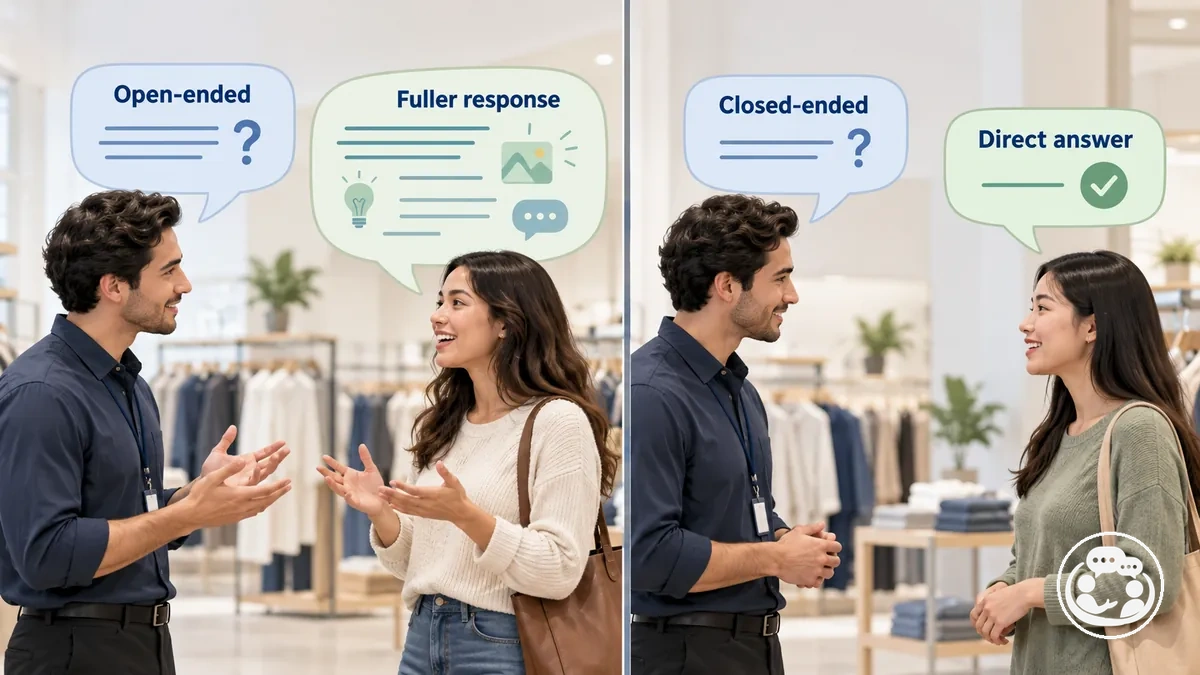
The table compares response range, information depth, confirmation value, and unexpected information because these shared criteria determine what information each question form can gather.
| Comparison criterion | Open-ended questions | Closed-ended questions | Retail implication |
|---|---|---|---|
| Response range | Permits a broader response in the customer's own words. | Constrains the response to a specific fact, choice, or confirmation. | The question form determines how much response freedom the customer has. |
| Information depth | Can yield explanation, detail, and information beyond the immediate prompt. | Yields a direct answer within the boundaries established by the question. | The associate can gather fuller detail or verify specific information according to the information need. |
| Confirmation value | May reveal the reasoning or context behind a customer's position. | Can directly confirm a defined fact, preference, or choice. | A bounded response can establish specific information when confirmation is required. |
| Unexpected information | Leaves room for the customer to introduce relevant details not specified in the question. | Limits information outside the response options or boundaries presented. | A broader response can reveal unanticipated detail, while a bounded response keeps the information focused. |
Open-Ended Questions Invite Explanation and Detail
Open-ended questions create room for explanation rather than a fixed response, allowing customers to answer in their own words.
This response breadth can invite detail about a customer's motivation, preference, concern, or context.
The information may be fuller or less predictable because the customer can elaborate beyond predefined choices, although the usefulness of that detail depends on the wording, context, and customer's willingness to explain.
For example, asking a customer, “What are you looking for in a jacket?” may surface an intended use, a preference, and a concern within the same response.
This illustrates how an unrestricted prompt can make several relevant details available for the associate to listen to and interpret without assuming that a longer answer is automatically a better answer.
The image illustrates how one unrestricted retail prompt can surface several distinct kinds of customer information in a single response.

Closed-Ended Questions Narrow the Response to a Fact, Choice, or Confirmation
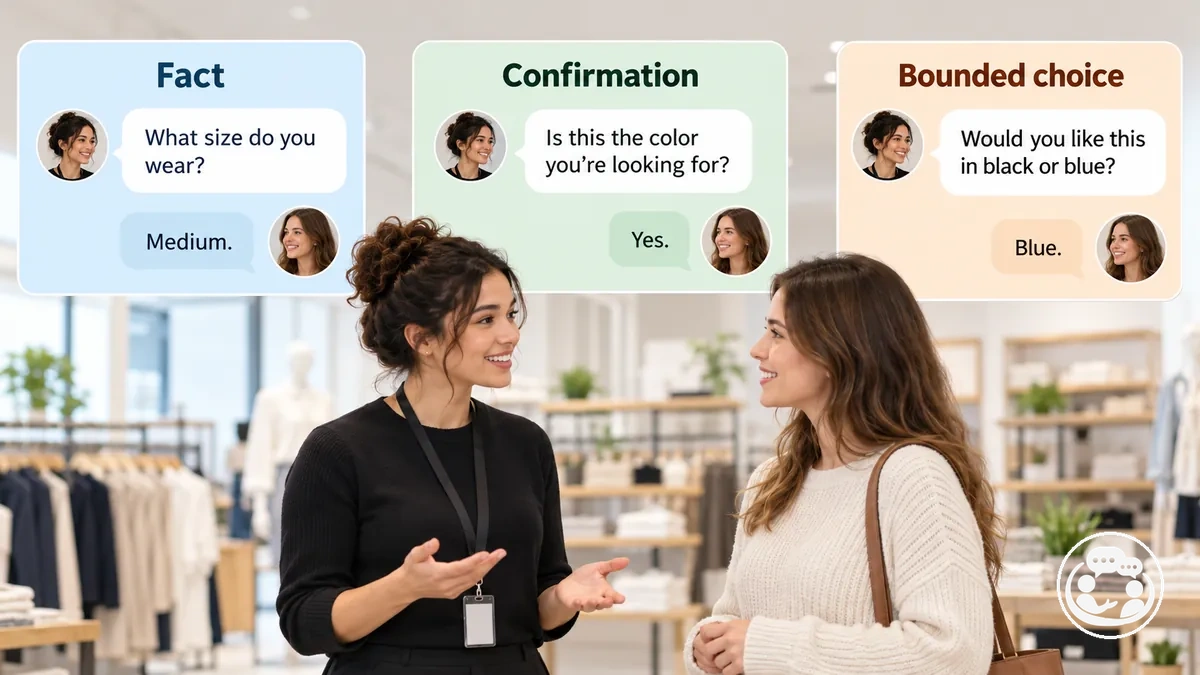
Closed-ended questions restrict the customer response to a defined answer space, producing a direct answer such as yes or no, a specific fact, or a bounded choice.
A closed-ended question may therefore request a fact or bounded choice as well as yes/no confirmation.
This restricted response can support clarification by verifying a specific detail, while leaving less opportunity for the customer to introduce information outside the question's boundaries.
For example, asking “Do you need the jacket for wet weather?” requests confirmation of a specific requirement and can verify that detail without reopening the broader conversation.
The image distinguishes factual, confirmation, and bounded-choice forms to show how closed-ended questions can constrain customer responses in different ways.
Benefits and Limits of Each Question Type
Open-ended and closed-ended questions each offer a benefit under some conditions and a limitation under others.
Open-ended questions provide greater response freedom, which can increase information depth and reveal unexpected information, but they can also require more response effort and interpretation.
Closed-ended questions constrain the response, which can support clarity and confirmation when a specific detail is needed, but that same constraint can limit elaboration and leave unprompted information undisclosed.
The useful question type therefore depends on the informational job in the retail conversation rather than on a universal preference.
The main trade-offs concern information depth, clarity, response effort, confirmation value, and the opportunity for unexpected detail.
The same dimension can be an advantage in one condition and a limitation in another, depending on whether the associate needs exploration or a bounded answer.
The graphic summarizes these conditional trade-offs without ranking either question type.
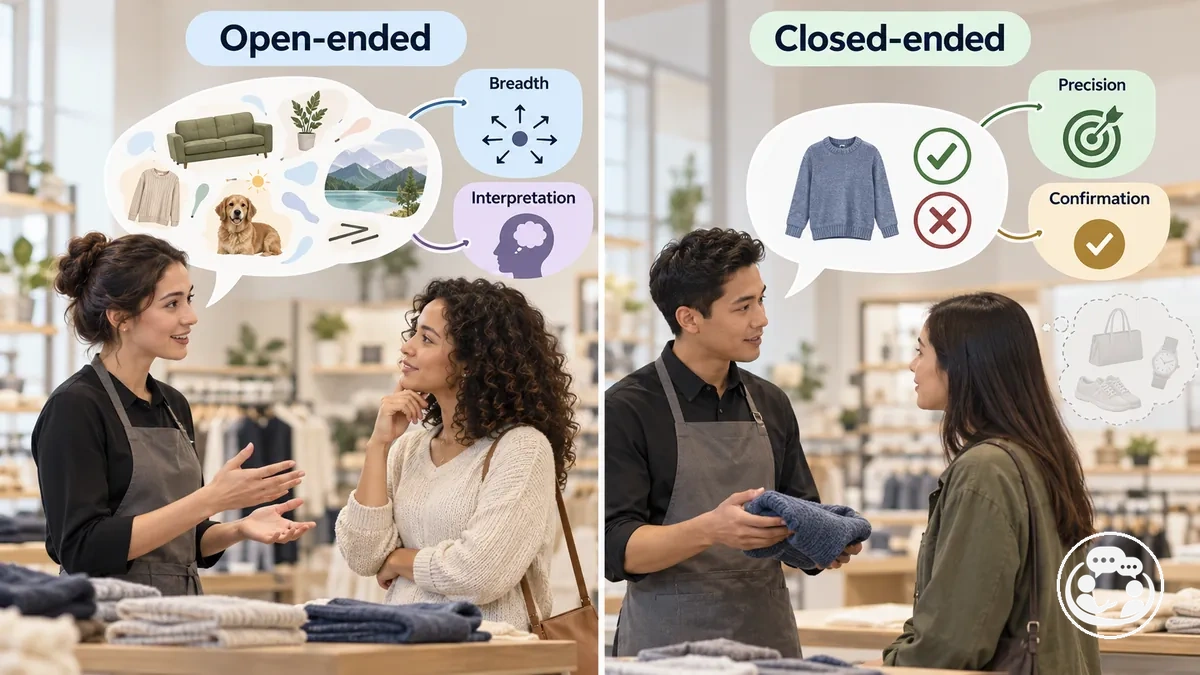
The table applies the same criteria to both question types so that each benefit and limitation remains tied to the information needed and its practical implication.
| Criterion | Open-ended questions | Closed-ended questions | Practical implication |
|---|---|---|---|
| Information depth | Can invite elaboration and provide greater depth when the customer has relevant detail to share. | Constrains information to the fact, choice, or confirmation requested. | Greater response breadth suits a need for detail; greater constraint suits a need for specific information. |
| Clarity | Broader responses may require interpretation before a specific detail is clear. | Can reduce ambiguity when the question defines the specific information required. | A bounded question can help when clarification of a defined detail is the immediate need. |
| Response effort | Requires the customer to formulate a response in their own words. | Limits the customer response to a narrower answer space. | The suitable level of response effort depends on whether explanation or a specific answer is needed. |
| Confirmation value | Can reveal context behind a customer's position without necessarily confirming a defined point directly. | Can confirm a specific fact, choice, or stated preference when the wording is clear. | A closed-ended question can serve a confirmation need, while an open-ended question leaves more room for context. |
| Unexpected information | May reveal relevant details that were not explicitly prompted. | Can limit information outside the boundaries established by the question. | Response freedom can surface unanticipated detail, while response constraint keeps the answer focused on specified information. |
Benefits and Limits of Open-Ended Questions
Open-ended questions can surface unanticipated information about customer needs, reasons, preferences, and concerns, but the same response freedom can require more time and interpretation.
A richer response may broaden the available detail when the information is relevant, while also increasing the amount the retail associate must assess for relevance.
Open-ended questions may therefore produce less focused answers when customers include context that does not directly address the immediate information need.
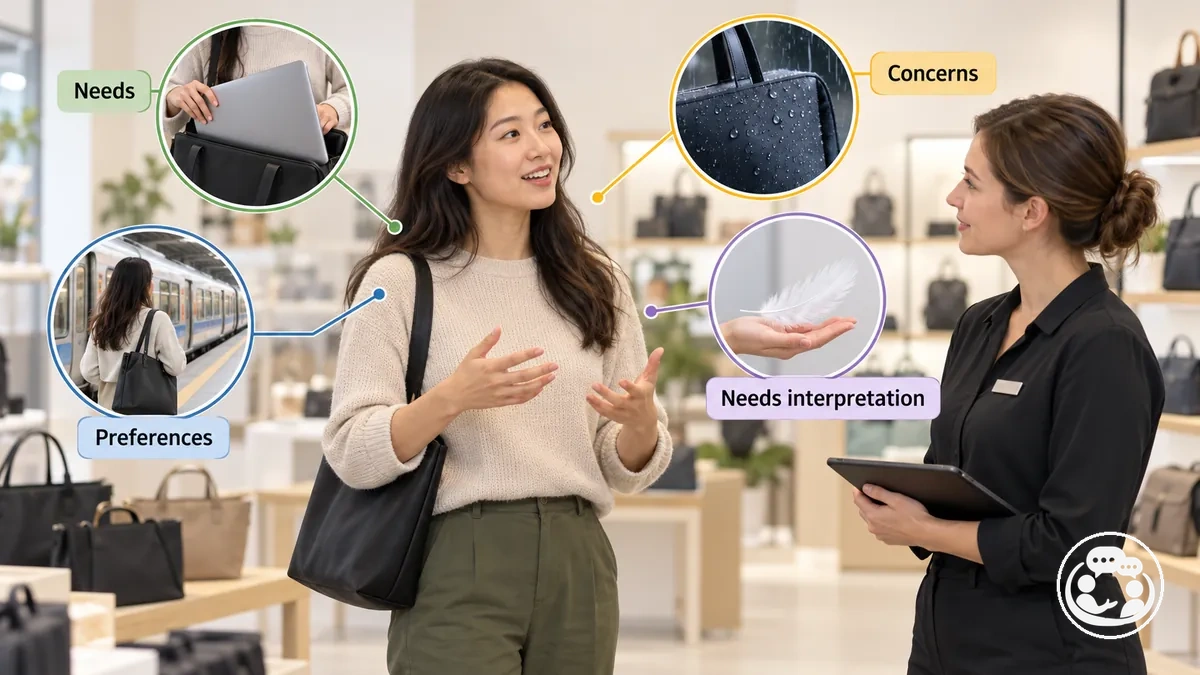
For example, a customer asked what matters most when choosing a work bag might mention carrying a laptop, travelling by train, preferring a lighter bag, and worrying about rain protection.
Those details can reveal needs and concerns that a predetermined answer set might not have captured, while the associate still has to interpret which details are relevant to the customer's immediate choice.
The image makes this benefit-limit pairing concrete by distinguishing useful customer detail from information that still requires interpretation.
Benefits and Limits of Closed-Ended Questions
Closed-ended questions can verify facts and reduce ambiguity when the retail associate needs confirmation of a known detail, but their restricted response also creates an information constraint.
A direct answer can clarify the specific point asked about while limiting unprompted context that may be relevant to the customer's situation.
The same restriction that can improve precision may therefore reinforce an incorrect assumption or leave unresolved information that requires further exploration.
For example, confirming that a customer needs a jacket for wet weather can establish that requirement, but it does not reveal whether warmth, weight, or intended use is also a concern.
The confirmation is useful for the specific fact, while the unresolved detail may require a further question rather than treating the bounded answer as sufficient.
When to Use Each Question Type in a Retail Conversation
Choose the question type according to the current information gap in the retail conversation.
Open-ended questions tend to fit exploration when the associate needs the customer to elaborate, while closed-ended questions tend to fit confirmation when a known detail needs a direct answer.
Clarification and narrowing can use either form depending on what is already known and what remains uncertain.
The appropriate question choice can therefore change as the customer response changes the available information.
Exploration, clarification, confirmation, and narrowing describe information states rather than fixed sales stages.
Match the question to the information gap
- Need to explore: Open-ended questions are useful when the information gap is broad and the associate needs explanation about needs, preferences, reasons, or concerns; the customer response can introduce detail that was not already specified.
- Need to clarify: Use an open-ended question when the uncertainty requires elaboration, or a closed-ended question when clarification depends on verifying one defined point; the form should match what remains unclear.
- Need to confirm: Closed-ended questions are useful when a known detail needs confirmation or verification; a direct answer can establish that point while leaving unrelated context unexplored.
- Need to narrow: Closed-ended questions can narrow several possibilities to a specific fact or choice when the relevant options are already understood; if important context remains unknown, further exploration may still be needed.
For example, an associate might first use an open-ended question to explore what a customer needs from a jacket, then use a closed-ended question to confirm whether rain protection is required.
This change in question type reflects a change in the information gap, not a fixed open-first or closed-first rule.
Use Open-Ended Questions When the Customer Needs Room to Explain
A customer may ask for a product while the associate still has an incomplete understanding of the customer goal, preference, concern, intended use, or reason for shopping.
In that situation, open-ended questions can invite an explanation that provides context the initial request did not contain.
For example, a customer asking for a bag might explain that it needs to carry a laptop during a train commute, changing the associate's interpretation from a general bag request to a more specific intended use.
The value of the open question depends on whether the customer is willing and able to elaborate.
Where an information gap remains, the customer's explanation can add context that clarifies what matters about the request without assuming that the first stated preference represents the complete need.
This makes open-ended questions useful when further elaboration could materially change the associate's understanding of the customer's goal, preference, concern, or reason for shopping.
Use Closed-Ended Questions When a Specific Detail Needs Confirmation
Closed-ended questions fit when the associate already has a plausible specific detail but needs confirmation before relying on it.
For example, a customer may mention a product preference that suggests a particular size, but the associate can verify the size rather than carry that assumption forward.
The same verification approach can apply to a known or suspected detail about timing, preference, or compatibility when the question can be answered with a bounded answer.
Confirmation establishes a more reliable fact for the next response while remaining limited to the detail that was actually confirmed.
A closed-ended question can therefore clarify whether the associate's current understanding is correct without treating an assumption as established information.
If the bounded answer contradicts the proposed detail, the associate has a clear reason for further clarification; if it confirms the detail, that reliable fact can inform the next conversational decision without implying that other customer needs have also been verified.
Move Between Open Exploration and Closed Confirmation as the Conversation Changes
Associates can switch between open and closed questions as the conversation changes, using the current information gap and level of uncertainty to guide each follow-up.
- Explore: use an open-ended question when the need or context is still unclear.
- Confirm: use a closed-ended question once a specific new detail is defined well enough to verify.
- Reopen: return to exploration if a later answer creates new ambiguity rather than forcing the conversation toward confirmation.
For example, a customer looking for a jacket might first explain that it is for commuting, then mention that wet weather is a concern.
The associate can clarify what matters about the commute, confirm a specific detail such as whether rain protection is required, and reopen exploration if the answer introduces a new uncertainty about intended use.
This explore → clarify → confirm pattern illustrates how question choice can adapt to what the customer actually says rather than follow a predetermined sequence or ratio.
Open-Ended and Closed-Ended Question Examples for the Same Retail Situation
Holding the same retail situation constant makes the wording difference between an open-ended version and a closed-ended version easier to compare.
Each question form changes the response range available to the customer and, as a result, the informational consequence for the associate.
The paired examples below use the same fields so that each customer response can be compared by the information the wording invites or restricts.
The responses described are illustrative possibilities rather than predetermined customer behaviour.
| Retail situation | Open-ended version | Closed-ended version | What changes in the response |
|---|---|---|---|
| Initial need exploration | “What do you need the jacket for?” | “Do you need the jacket for commuting?” | The open-ended version invites the customer to explain the intended use in their own terms, creating a broader response range. The closed-ended version asks for confirmation of one proposed use, so the information gained is limited to whether that specific assumption is confirmed. |
| Preference clarification | “What matters to you about the way the bag feels to carry?” | “Do you prefer a lighter bag?” | The open-ended version can elicit the customer's own preference criteria, while the closed-ended version restricts the response to a specific proposed preference. The informational consequence is broader explanation in one form and focused clarification in the other. |
| Final confirmation of a known detail | “What would you like to confirm about the size?” | “Is medium the size you want?” | The open-ended version leaves room for the customer to raise more than one size-related consideration. The closed-ended version confirms one already identified detail, producing a narrower response when that specific fact is what the associate needs to verify. |
These pairs do not make either question form the preferred choice in every situation.
They show how changing the wording while holding the scenario constant changes what information the customer has room to provide.
How to Reframe a Closed Question as an Open Question
To reframe a closed question as an open question, preserve the informational goal while removing the restricted response built into the original question.
The revised open prompt should give the customer more response freedom without changing what the associate needs to understand.
Prompts using what, how, or tell me about can broaden the response range when the rest of the wording also leaves room for explanation.
The purpose is not to convert every closed question, but to reformulate one when a broader answer space would better serve the information need.
The rewriting logic moves from the response constraint to the information actually needed, then to wording that allows the customer to supply that information more freely.
The final check is whether the reformulated question still leads the customer toward a particular answer or retains another unnecessary constraint.
- Identify the restriction: Examine the original question and identify the restricted response it permits, such as yes or no, one fact, or a bounded choice.
- Identify the information needed: State the informational goal separately from the original wording so the rewrite preserves what the associate actually needs to learn.
- Rewrite with an open prompt: Use wording such as what, how, or tell me about when it allows explanation and broadens the response range without changing the informational goal.
- Check for leading or residual constraints: Verify that the revised question does not suggest the preferred answer or continue to restrict the customer to the assumptions contained in the original question.
For example, “Do you need a lightweight bag?” can become “What matters to you about carrying the bag?”, preserving the goal of understanding carrying preferences while allowing factors beyond weight to emerge.
“Is this jacket for commuting?” can become “Tell me about when you expect to wear the jacket,” which broadens the answer space around intended use; a later follow-up can confirm a specific detail if needed.
Changing the first word alone does not guarantee a genuinely open question, and mechanically adding “why” can leave the original restriction or leading assumption intact.
Replace a Restricted Answer with a Prompt for Explanation
Replace a restricted answer with an open prompt that preserves the original informational goal while asking the customer to describe the relevant need or preference.
Instead of limiting the response range to yes/no, one fact, or a forced choice, reformulate the wording with what, how, or tell me about when those forms invite relevant explanation.
The revised wording should broaden the answer space without changing the subject of the original question.
It should also remain specific enough that the invited detail is relevant to the information being sought.
Restricted → open
- Restricted
- “Do you want a formal jacket?”
- Open
- “Tell me about the occasions when you plan to wear the jacket.”
This preserves the focus on intended use while allowing the customer to describe what “formal” means in their situation.
- Restricted
- “Do you prefer a smaller bag?”
- Open
- “What matters to you about the size of the bag?”
The broader prompt can reveal whether the size preference relates to portability, carrying capacity, or another size-related need.
- Restricted
- “Is this difficult to carry?”
- Open
- “How does carrying this feel to you?”
This keeps the focus on carrying experience while allowing the customer to explain the relevant preference rather than accept or reject the original description.
Use an Open Follow-Up When a Closed Answer Needs More Context
Use an open follow-up only when a closed answer leaves missing context that could materially change its interpretation or the next action in the conversation.
A bounded answer may establish a useful fact or preference on its own, so elaboration is unnecessary when its meaning is already sufficient.
When the reason, preference, constraint, or meaning remains relevant but unclear, a context-seeking prompt can invite the customer to explain that specific gap.
The follow-up should clarify what matters without pressuring the customer for unrelated detail.
Use the follow-up only when the missing context matters
Closed answer: “No” to whether a jacket suits the customer’s needs.
Open follow-up: “What about the jacket does not suit what you need?”
The follow-up can clarify whether the relevant constraint is fit, intended use, or another feature.
Closed result: the customer chooses one bag over another.
Open follow-up, if needed: “What about this bag works better for you?”
If the choice already gives enough information, no elaboration is required; use the follow-up only when the reason affects the next action.