
Budget limit
- Signal
- A stated spending cap or clear affordability boundary.
- Clarify
- “What price range do you need to stay within?”
- Respond
- Look for a suitable option that meets the essential need within the stated budget.
When a retail customer says an item is “too expensive,” acknowledge the concern and clarify whether the issue is a budget limit, insufficient perceived value, or a comparison with another price or option. Respond to that condition, then check whether the price concern is resolved before continuing; if the customer clearly declines or no suitable option fits a genuine budget limit, stop respectfully.

Choose the response by what “too expensive” means
Start with a neutral acknowledgement, then use the customer’s explanation to choose the response path. One cue can suggest a direction, but it does not confirm the cause on its own.
“I understand the price is a concern. What about the price is giving you pause?”
Budget limit
Perceived-value concern
Comparison or expectation
Verify before moving on: ask how the customer now feels about the price. Continue when the concern is resolved, clarify when it remains open, and stop when the customer clearly declines or no feasible budget fit exists.
The phrase “too expensive” identifies the objection but not its cause. A low-pressure response avoids defending the price, listing unrelated features or offering a discount until the customer’s meaning is clearer.
When a retail customer says an item is “too expensive,” the objection may reflect a budget limit, insufficient perceived value, or a comparison with another price or expectation. The phrase alone does not establish which interpretation is correct, so use the customer’s words as cues for a follow-up question rather than as a diagnosis.

| Observed Cue | Possible Interpretation | Question to Clarify | Response Direction |
|---|---|---|---|
| The customer states a spending cap or says the item is outside the amount they planned to spend. | A genuine budget limit may be restricting the feasible option range. | “What price range were you hoping to stay within?” | Focus on options that fit the stated budget and customer need. |
| The customer asks what makes the item worth the price or questions features that matter to their need. | The price objection may reflect insufficient perceived value. | “Which part of what you need from the product matters most to you?” | Connect only relevant product benefits to the stated customer need. |
| The customer mentions a lower-priced alternative, another store, or a different expected price. | The concern may be based on a comparison or reference point. | “What are you comparing this option with?” | Clarify whether the alternatives are being compared on equivalent features, needs, or expectations. |
A stated spending cap is the clearest cue for a possible budget limit. Questions about whether features justify the price may indicate a value concern, while references to another seller, product, promotion or expected price may indicate a comparison.
Tone and prior interest can add context, but signals can overlap. Clarify the feasible spend for a possible budget limit, the relevant need for a possible value gap, or the reference point for a possible comparison before choosing the response direction.
A genuine budget limit is present when the customer states or maintains a spending cap that constrains what they are willing or able to spend, even if they understand the product’s value. In that situation, the objection is primarily about affordability and available spend rather than whether the product appears useful.

A value concern exists when the customer has not yet connected the price to a relevant benefit that supports their stated need, so perceived value remains insufficient. This differs from affordability: a shopper may be able to afford the item but not see enough value, while a budget concern can remain even when the shopper understands the value.
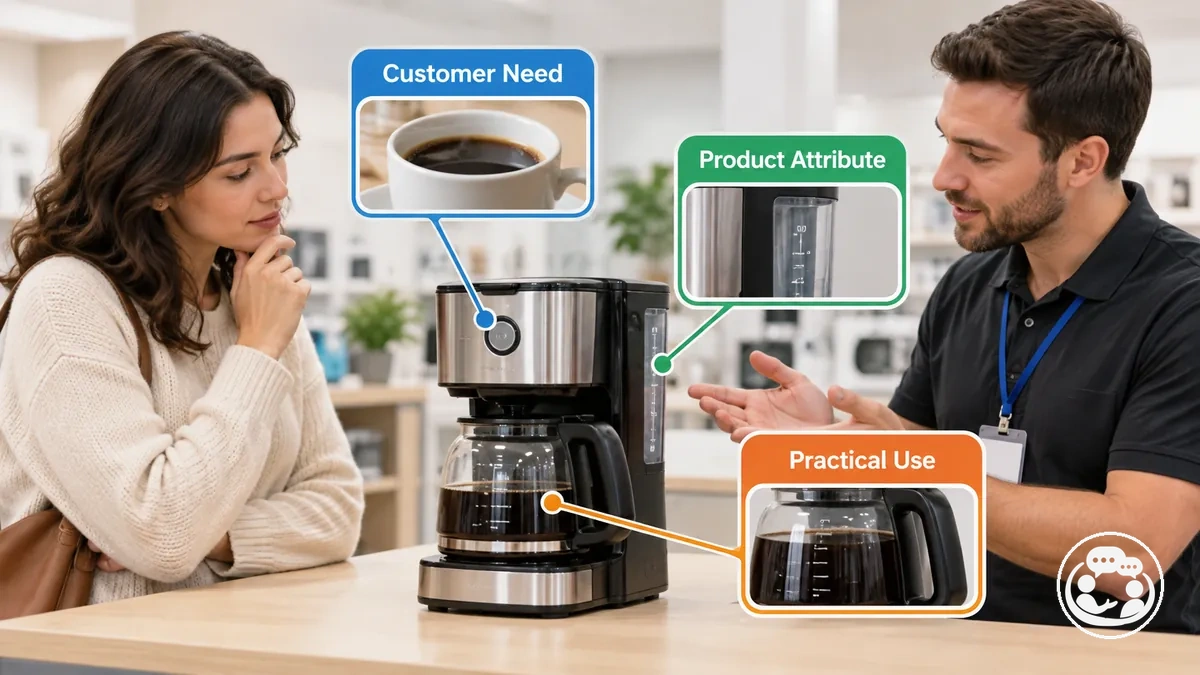
Start with the priority the customer has actually stated.
Use only a feature or capability the product genuinely has.
Explain how that attribute may help with the stated need.
Let the customer decide whether the usefulness changes how they view the price.
Clarify relevance without assuming that a higher price means better quality or pressuring the shopper to accept the price.
A shopper may call the current price “too expensive” because they are comparing it with another product, a prior price or promotion, or an expectation they already had. Here the concern is relative to a reference point rather than necessarily an affordability limit, so identify that reference point first.

Common reference points
Once the reference point is clear, isolate only a difference that matters to the customer’s stated need instead of comparing every available attribute. A relevant difference may affect the shopper’s price judgement, but it does not automatically make either option better value.
If the customer is comparing the current product with an alternative, clarify which feature, condition or expectation makes that alternative the meaningful benchmark. Keep any value claim limited to factual differences relevant to the customer.
Handle a retail price objection as a low-pressure sequence: acknowledge → clarify → respond to the identified condition → verify → continue or stop. Keeping that order helps avoid defending the price, explaining value or changing options before the salesperson understands what the objection means.
Use the sequence as a decision framework rather than a rigid script.

The branch occurs only after clarification: a perceived-value concern calls for a relevant explanation, while a genuine budget limit calls for an adjustment that respects the customer’s spending boundary. Verification then determines the next action from the customer’s response rather than from an assumed outcome.
Stopping is a valid result when the objection cannot be resolved respectfully or the customer does not want to continue.
Let the customer finish, listen to the full price concern, then pause briefly before acknowledging it. Use a neutral response rather than interrupting, debating the price, defending the product or immediately offering a discount.
Acknowledgement recognises what the customer has said; it does not mean agreeing that the item is objectively overpriced.
Use: neutral acknowledgement
“I understand the price is a concern for you.”
It recognises the concern without deciding what caused it and leaves room for clarification.
Avoid: immediate argument
“But the product is worth the price.”
It introduces disagreement before the salesperson knows whether the issue is budget, value or comparison.
Clarify why the price feels high before offering a solution. Start with an open question such as, “What about the price is giving you pause?” and let the customer’s answer determine whether a narrower follow-up is needed.
This follows the same principle as effective retail sales scripts: the customer’s stated need and answer content guide the response direction rather than the salesperson’s assumption.
An answer signal may suggest the next response direction, but a single ambiguous cue does not by itself establish why the customer considers the price too high.
Explain value through a relevant benefit tied to the customer’s expressed need rather than through a generic defence of the price. Use only supportable product claims, and do not make a discount the default response when the concern is about perceived value.
Anchor the explanation in what the customer says matters.
Choose only verified product facts that relate to that need.
Show how those attributes may help without claiming that price alone proves quality.
Ask whether that difference is meaningful enough to change their price view.
When a genuine budget limit has been established, shift from persuasion to finding a feasible fit within the customer’s budget ceiling, if an appropriate option actually exists. Keep the customer’s essential need as the decision anchor rather than pressuring them to spend beyond the stated limit.
For example, if the customer needs a particular core function but not an optional feature, an available alternative without that feature may fit the budget; the trade-off is the loss of that nonessential feature.
Verify whether the price concern is actually resolved before choosing the next action. Politeness, silence or an ambiguous response does not by itself confirm agreement, so use the customer’s explicit response and a neutral check-in question to establish the remaining state.
The verification separates explicit confirmation from uncertainty or a continuing objection without pressuring the customer to agree. A neutral check-in is: “How are you feeling about the price now?”
The same price objection can call for different wording because the shopper statement may reflect a budget limit, a perceived-value concern or a comparison with another reference point. These examples demonstrate the response logic rather than fixed wording to memorise.
Budget limit
Perceived-value concern
Comparison concern
The most damaging mistakes when responding to a retail price concern weaken diagnosis, reduce the relevance of the response or add unnecessary pressure. Recognising the cue and consequence makes the correction specific to what the customer has actually communicated.
Across these mistakes, the correction is not a stronger argument but a more relevant response: preserve clarity, connect value to the customer’s stated need where appropriate, and avoid adding pressure when the customer’s response does not support continuing.
Stop addressing the price objection when the shopper has clearly declined, when a genuine budget mismatch remains and no suitable option fits the customer’s essential need, or when further discussion would add pressure rather than useful information.
The stopping point depends on the customer’s signals and whether the conversation remains open to a useful next action. A clear decline or a verified budget mismatch with no feasible option is a boundary, not another objection to overcome.
This follows the same low-pressure principle used when closing a retail conversation without pressure: respect the customer’s choice instead of reopening the objection.