
Why Retail Sales Scripts Can Sound Robotic or Pushy
Retail sales scripts sound robotic when exact wording, fixed sequencing, or controlled delivery takes priority over responding to the shopper; they feel pushy when that rigidity reduces the shopper's practical space to pause, question, decline, or set the pace. The key is to keep the script's purpose consistent while letting wording, order, tone, pace, and pauses adapt to live shopper cues.

Delivery diagnosis at a glance
Use these four signals to identify where a prepared conversation is breaking down. A single signal is a clue, not proof of one underlying cause.
- Exact-wording recall
- Watch for: the associate concentrates on reproducing the line even after the shopper adds new information.
- Likely effect: delivery sounds recited or mechanical because recall competes with adaptation.
- Fixed next move
- Watch for: the planned next line stays unchanged when the shopper's answer changes the context.
- Likely effect: listening can appear superficial and the conversation becomes less responsive.
- Tone, pace, and pauses
- Watch for: flat emphasis, rushed delivery, or too little space between turns for the current interaction.
- Likely effect: the same wording can feel more mechanical, urgent, or pressuring.
- Space for shopper choice
- Watch for: hesitation, questions, or attempts to slow down are followed by continued pressure or assumed agreement.
- Likely effect: the delivery feels pushy because the shopper has less practical room to respond or choose.
Decision rule: prepared language should guide the purpose of the conversation, not override the live exchange. Keep the objective stable; adapt the wording and progression to what the shopper actually says and does.
Table of Contents
Robotic Delivery and Pushy Delivery Are Different Problems
Robotic delivery mainly describes a rehearsed or mechanical presentation, while pushy delivery concerns perceived pressure and reduced conversational space.
The distinction is useful because each problem changes the customer experience in a different way.
A compact comparison across observable delivery, customer experience, and immediate conversational effect separates the two states without assigning either one a specific cause.
| Comparison dimension | Robotic delivery | Pushy delivery |
|---|---|---|
| Observable delivery | Speech appears rehearsed or mechanical, with weak adaptation to the shopper's responses. | Speech or questioning limits conversational space by continuing to press the interaction or direction. |
| Customer experience | The interaction can feel impersonal because the delivery appears insufficiently responsive to the shopper. | The interaction can feel pressuring when the shopper perceives less room for customer choice. |
| Immediate conversational effect | The exchange can lose natural responsiveness even when the associate is not applying pressure. | The shopper can experience reduced conversational space even when the wording itself does not sound mechanical. |
Robotic delivery and pushy delivery can overlap, but their primary manifestations are not identical.
A mechanical presentation can also feel pressuring, yet either state alone does not prove one specific underlying cause.

Robotic Delivery Sounds Rehearsed Instead of Responsive
Robotic delivery can sound rehearsed when a recited cadence continues with little responsiveness to shopper input.
The interaction may appear mechanical when the associate shows limited acknowledgement or adaptation as the shopper responds.
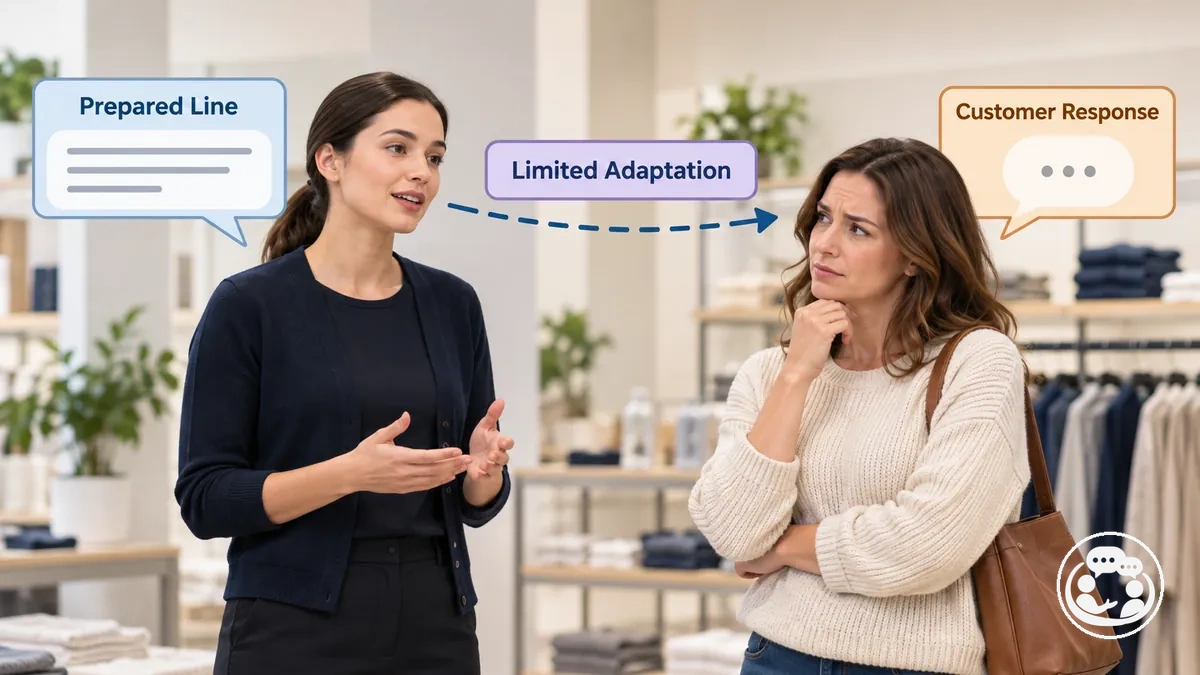
This delivery can feel detached or pre-recorded even when the prepared wording itself is reasonable.
For example, a shopper may express a preference, while the associate continues the rehearsed line without acknowledging that input.
That pattern can help identify robotic delivery, but it does not by itself establish the underlying cause.
Pushy Delivery Leaves Too Little Space for Customer Choice
Pushy delivery creates conversational pressure when the shopper has too little response space to hesitate, decline, or set the pace.
Urgency, interruption, or assumed agreement can limit customer choice when they repeatedly move the conversation forward.
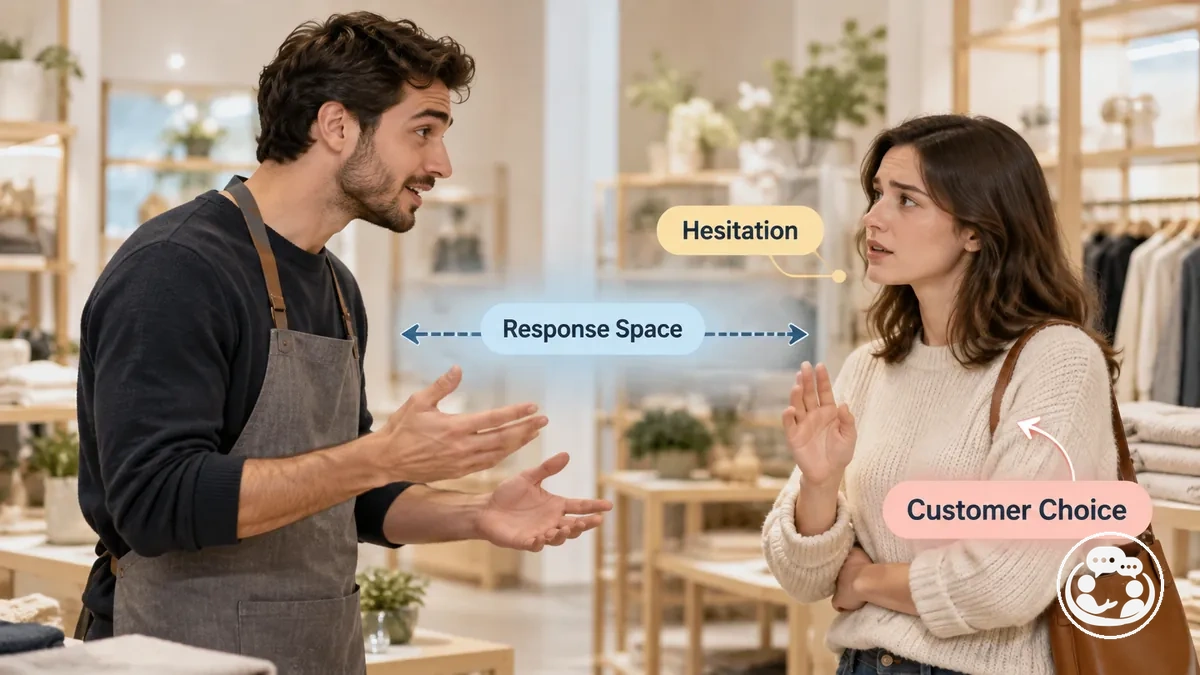
For example, a shopper may express hesitation while the seller continues speaking as though agreement has already been reached.
Persistence does not necessarily equal pushiness; the key distinction is whether the interaction reduces the customer's practical space to respond or choose.
Word-for-Word Memorisation Makes a Script Sound Rehearsed
Word-for-word memorisation can shift prepared language toward recitation when the associate concentrates on recalling exact wording during a live exchange.
Dependence on verbatim recall can make a customer response or deviation harder to absorb without disrupting rehearsed delivery.
The main mechanisms involve where attention goes when exact wording becomes the associate's immediate reference point rather than the changing conversation.
- Attachment to exact wording can keep attention on recall while the shopper is providing new information.
- A customer response that differs from the expected exchange can create tension between prepared language and live input.
- An interruption or deviation can make returning to a memorised sequence feel more noticeably recited or rehearsed.
An unexpected answer can expose this tension when the shopper changes direction while the associate is still recalling the prepared line.
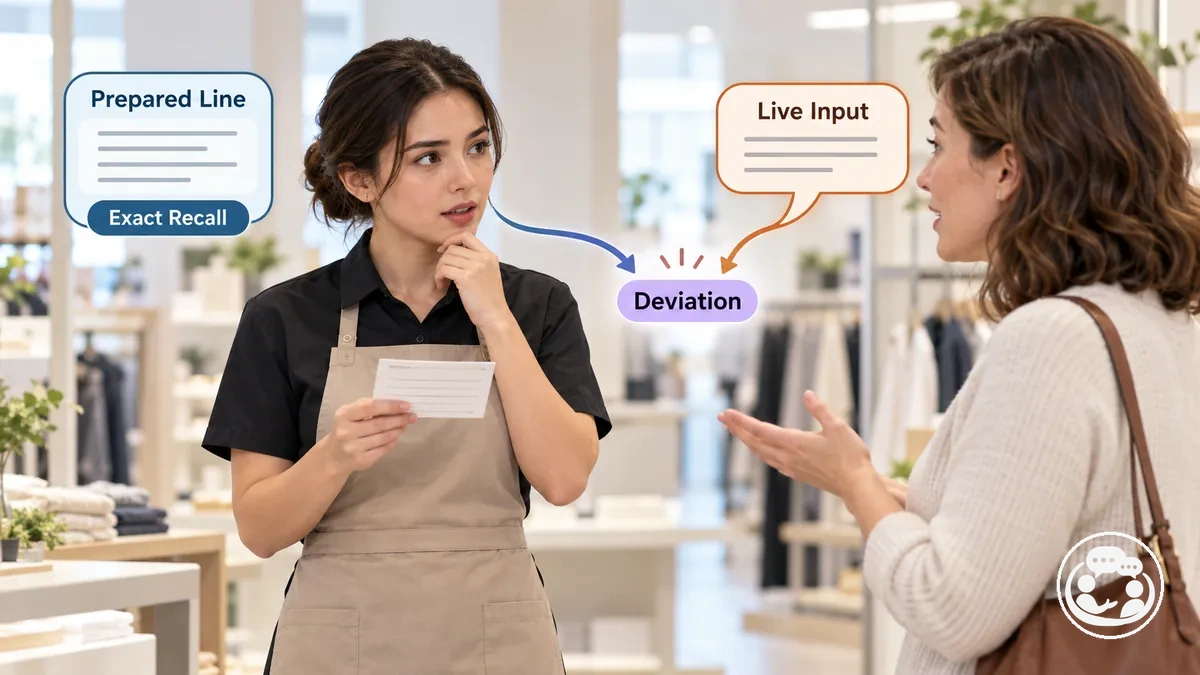
For example, a shopper may introduce a different priority, while the associate continues the memorised wording before acknowledging that response.
Learning the script's intent and key ideas keeps the message consistent without making verbatim recall the target, so preparation itself does not necessarily produce rehearsed delivery.
Fixed Wording and Sequence Make the Conversation Less Responsive
Fixed wording can reduce responsiveness when the same next move follows regardless of the shopper's latest response or signal.
A rigid sequence can therefore create a conversational mismatch when shopper cues no longer fit the script's expected direction.
The relevant factor is the script's degree of rigidity, not simply whether the sales process has a repeatable structure.
When a script assumption differs from the shopper's actual condition, limited flexibility can make the next prepared move less responsive.
Common mismatches appear when the script assumption stays fixed while the shopper's needs or readiness change.
- The script assumes a predictable answer, but an unexpected customer response changes what needs acknowledgement next.
- The sequence assumes enough information is available, but the shopper needs more context before moving forward.
- The next move assumes readiness to continue, but customer cues indicate hesitation or a need for more conversational space.
One customer may give an unexpected answer while the fixed sequence still directs the associate toward the planned next line.
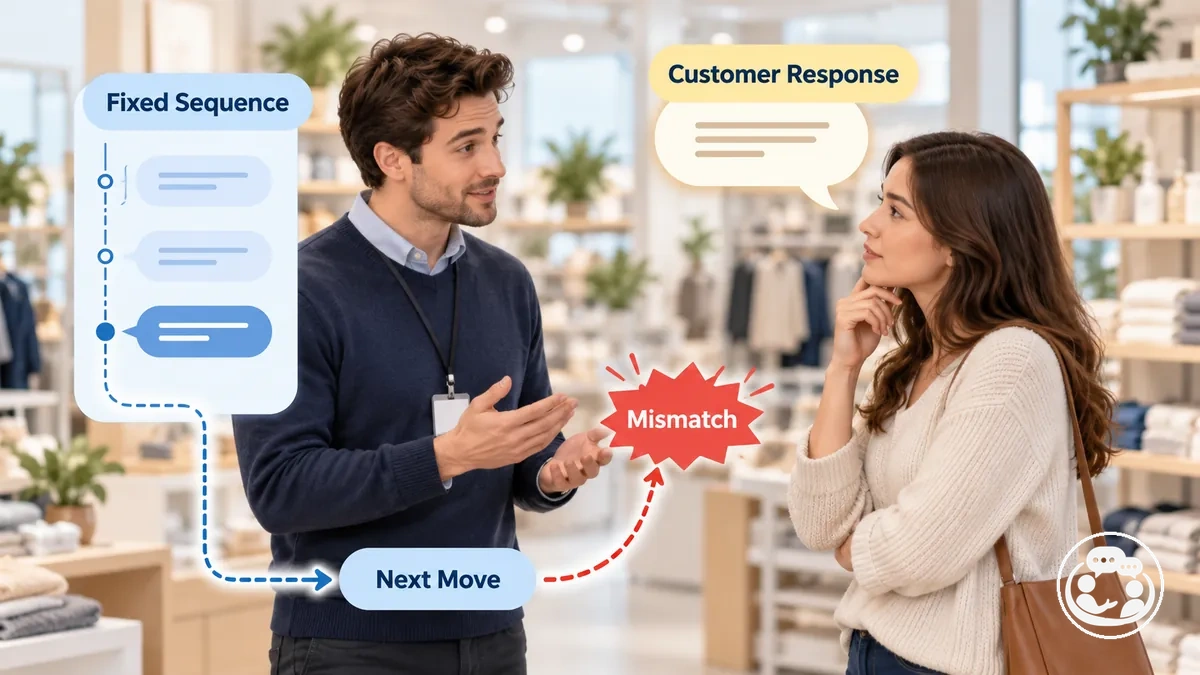
Consistency of purpose does not require rigidity of wording. A repeatable sales process can keep its objective stable while allowing the wording and sequence to change around live shopper input.
This distinction explains the responsiveness problem without turning the section into a method for writing or adapting flexible scripts.
Moving to the Next Line Can Override the Customer's Answer
The clearest test is whether the shopper's answer changes what happens next.
Fixed continuation
The shopper answers, the associate acknowledges it, then returns to the predetermined next line. The unchanged move does not reflect the new information.
Responsive continuation
The shopper answers, and the associate changes the next response or question to fit what was actually said while preserving the conversation's purpose.
Preset Timing Can Miss the Customer's Actual Context
Preset timing can feel premature when the shopper's readiness or engagement does not support the planned progression.
When engagement is clear
A planned next move may feel natural when the shopper is actively responding and the conversation is already moving forward.
When more time is needed
Short answers, pauses, hesitation, or a need for clarification are cues to slow the progression instead of following a fixed timing assumption.
Practical rule: appropriate pacing follows the shopper's observable context and response cues rather than a preset script beat.
Tone, Pace, and Pauses Change How the Same Sales Script Is Perceived
The same words can land differently because tone, pace, and pauses change perceived urgency, confidence, responsiveness, and conversational openness.
Variations in pitch, speaking speed, and conversational space can therefore influence customer perception without changing the script itself.
These delivery attributes can create different impressions when their state becomes rigid or poorly matched to the interaction.
| Delivery attribute | Extreme or rigid state | Likely conversational effect |
|---|---|---|
| Tone and pitch | Little tonal or pitch variation | Delivery may sound rehearsed or less responsive to the shopper's input. |
| Volume | Volume poorly matched to the interaction | Delivery may convey unintended intensity or reduced conversational openness. |
| Pace and speaking speed | Speech moves quickly without adapting to the shopper | The interaction may convey urgency or leave less space for the shopper to process and respond. |
| Pauses | Minimal pauses between prompts or statements | Reduced conversational space may make turn-taking feel constrained. |
These effects remain context-dependent because no single vocal adjustment guarantees confidence, trust, or a particular customer response.
For example, the same prepared line can sound open with measured pacing and pauses, yet urgent when delivered quickly without response space.
Flat or Over-Controlled Tone Makes Delivery Sound Mechanical
A flat tone or tightly controlled tone can make prepared language sound mechanical when vocal emphasis remains limited or emotionally mismatched.
Mechanical delivery becomes more noticeable when tonal variation does not respond naturally to the meaning of the exchange.
A calm tone can remain steady and responsive, while flat delivery lacks meaningful variation or emotional fit.
For example, similar wording can sound attentive with modest tonal variation but detached when every phrase receives identical emphasis.
The distinction depends on vocal emphasis fitting the conversational meaning rather than using one ideal tone pattern.
Fast Pacing and Too Few Pauses Make Delivery Feel Pressuring
Fast pacing and too few pauses can compress turn-taking, reducing the shopper's response opportunity and conversational space. A high speaking speed may also increase perceived urgency or pressure when the shopper needs time to respond.
For example, uninterrupted delivery can move through the same message before the shopper has an opportunity to answer, while a well-timed pause can leave more room for the shopper to respond.
Using a Script Is Different From Sounding Scripted
Using a script as a guide can support preparation and consistency without requiring an associate to recite fixed lines.
Sounding scripted becomes more likely when prepared language overrides flexibility, listening, and responsiveness to shopper input.
The distinction becomes clearer when the same prepared material is compared by how it functions during a live conversation.
| Dimension | Script as a guide | Script treated as fixed lines |
|---|---|---|
| Flexibility | Talking points can adapt to the direction and context of the conversation. | Verbatim wording remains the priority even when the conversation changes. |
| Listening | Customer input can influence what the associate acknowledges or discusses next. | The next prepared line can continue with limited adjustment to shopper input. |
| Wording | Prepared language supports the intended message without requiring identical phrasing. | Prepared language is treated as wording that should be repeated closely or exactly. |
| Responsiveness | The associate can preserve consistency while responding to the shopper's immediate needs. | Consistency can become rigidity when the prepared sequence takes priority over the shopper's response. |
Preparation and consistency can remain useful without making every retail interaction follow identical wording or sequence.
The relevant distinction is not script versus no script, but whether prepared language remains subordinate to the live conversation.